Question
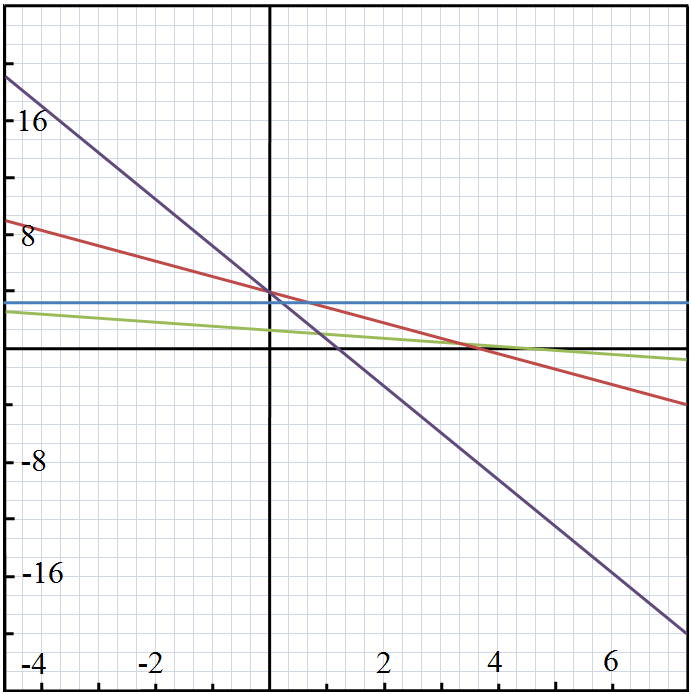
Find the linear inequations for which the solution set is the shaded region given in Fig.
Answer


Consider the line x + y = 4. We observe that the shaded region and the origin are on the same side of the line x + y = 4 and (0, 0) satisfies the linear inequation $\text{x}+\text{y}\leq4.$ So, we must have one inequations as $\text{x}+\text{y}\leq4.$

Consider the line y = 3. We observe that the shaded region and the origin are on the same side of the line y = 3 and (0, 0) satisfies the linear inequation $\text{y}\leq3$ so, the second inequations is $\text{y}\leq3.$

Consider the line x = 3.

We observe that the shaded region and the origin are on the same side of the line x = 3 and (0, 0) satisfies the linear inequation $\text{x}\leq3$ so, the third inequations is $\text{x}\leq3$

Consider the line x + 5y = 4. We observe that the shaded region and the origin are on the opposite sides of the line x + 5y = 4 and (0, 0) does not satisfy the inequation $\text{x} + 5\text{y} \geq 4.$ so, the fourth inequations is $\text{x} + 5\text{y} \geq 4.$

Finaly, consider the line 6x + 2y = 8. We observe that the shaded region and the origin are on the opposite sides of the 6x + 2y = 8 and(0, 0) does not satisfy the inequation 6x + 2y = 8.

so the fifth inequations is 6x + 2y = 8,

we also, notice that the shaded region is above x-axis and is on the right side of y-axis. So, we must have $\text{x}\geq0$ and $\text{y}\geq0$

Thus, the linear inequations corresponding to the given solution set are

$\text{x}+\text{y}\leq4,\text{y}\leq3,\text{x}\,\leq3\text{x}+5\text{y}\geq4,,6\text{x}+2\text{y}\geq8,\text{x}\geq0,\text{y}\leq0$

Need a full question paper?

Generate a complete, print-ready paper with questions like this in minutes — across 16+ boards, with answer keys.

Start Generating Free

Similar questions

Prove the following by the principle of mathematical induction:
1 × 1! + 2 × 2! + 3 × 3! + ... + n × n! = (n + 1)! - 1 for all $\text{n}\in\text{N}$
Find the term independent of $x$ in the expansion of the following expressions:
$\Big(\frac{3}{2}\text{x}^{2}-\frac{1}{3\text{x}}\Big)^{6}$
If $\alpha+\beta=\frac{\pi}{2},$show that the maximum value of $\cos\alpha\cos\beta\text{ is }\frac{1}{2}.$
The diameters of circles (in mm) drawn in a design are given below:
Diameters 33-36 37-40 41-44 45-48 49-52
No. of circles 15 17 21 22 25
Calculate the standard deviation and mean diameter of the circles.
[Hint First make the data continuous by making the classes as $32.5-36.5, 36.5-40.5, 40.5-44.5, 44.5 - 48.5, 48.5 - 52.5$ and then proceed.]
Let r and n be positive integers such that 1 < r < n. Then prove the following:
$\frac{{^\text{n}}\text{C}_{\text{r}}}{{^\text{n}}\text{C}_{\text{r}-1}}=\frac{\text{n}-\text{r}+1}{\text{r}}$
Prove the following statement by principle of mathematical induction:
$1 + 2 + 2^2 + ...... + 2n = 2^{n+1} - 1$ for all natural numbers.
Find the equation to the ellipse in the following case:
eccentricity $\text{e}=\frac{1}{2}$ and semi-major axis $= 4$
Prove that: $4 \sin A \sin \left(60^{\circ}- A \right) \sin \left(60^{\circ}+ A \right)=\sin 3 A$. Hence deduce that: $\sin 20^{\circ} \times \sin 40^{\circ} \times \sin 60^{\circ} \times \sin 80^{\circ}=\frac{3}{16}$
Evaluate the following limit:
If $\lim\limits_{\text{x}\rightarrow0}{\text{ kx cosec x}}=\lim\limits_{\text{x}\rightarrow0}\text{ x cosec kx,}{}$ find k.
Solve the following equations:
$\sin\text{x}-3\sin2\text{x}+\sin3\text{x}=\cos\text{x}-3\cos2\text{x}+\cos3\text{x}$