Question
Find the matrix $A,$ If $B =\left[\begin{array}{ll}2 & 1 \\ 0 & 1\end{array}\right]$ and $B^2=B+\frac{1}{2} A$

Answer

$B^2=B+\frac{1}{2} A$
$A=2\left(B^2-B\right)$
$\begin{array}{l}B^2=\left[\begin{array}{ll}2 & 1 \\ 0 & 1\end{array}\right]\left[\begin{array}{ll}2 & 1 \\ 0 & 1\end{array}\right] \end{array} $
$ =\left[\begin{array}{llll}4 & +0 & 2 & +1 \\ 0 & +0 & 0 & +1\end{array}\right]  $
$=\left[\begin{array}{ll}4 & 3 \\ 0 & 1\end{array}\right] $
$\begin{array}{l}=B^2-B=\left[\begin{array}{ll}4 & 3 \\ 0 & 1\end{array}\right]-\left[\begin{array}{ll}2 & 1 \\ 0 & 1\end{array}\right] \end{array} $
$ =\left[\begin{array}{ll}2 & 2 \\ 0 & 0\end{array}\right]$
$A=2\left(B^2-B\right)$
$=2\left[\begin{array}{ll}2 & 2 \\ 0 & 0\end{array}\right]$
$=\left[\begin{array}{ll}4 & 4 \\ 0 & 0\end{array}\right]$

Need a full question paper?

Generate a complete, print-ready paper with questions like this in minutes — across 16+ boards, with answer keys.
Start Generating Free

Similar questions

Prove the following identity:
$
\operatorname{cosec}{ }^4 A-\operatorname{cosec} c^2 A=\cot ^4 A+\cot ^2 A
$
If the product of two consecutive even integers is $224$, find the integers.
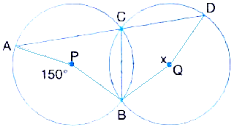
In the figure, given below, P and Q are the centres of two circles intersecting at B and C ACD is a straight line. Calculate the numerical value of x .
Image
A page from the passbook of Mrs. Rama Bhalla is given below:
Calculate the interest due to Mrs. Bhalla for the period from January $2004$ to December $2004,$ at the rate of $5\%$ per annum.
Date
Year 2004
Particulars Amount
(₹) Withdrawals
Amount
(₹)Deposits
Balance (₹)
January 1 B/F - - 2,000.00
January 9 By cash - 200.00 2,200.00
February 10 To cheque 500.00 - 1,700.00
February 24 By cheque - 300.00 2,000.00
July 29 To cheque 200.00 - 1,800.00
November 7 By cash - 300.00 2,100.00
December 8 By cash - 200.00 2,300.00
A well of diameter 1 m is dug 7 m deep. The earth taken out of it is completely used for making a conical body of scare-crow. The base diameter of the body is 2 m. Find the height of scare-crow.
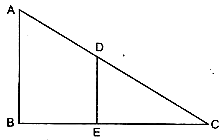
In the given figure, AB and DE are perpendicular to BC.
(i) Prove that ΔABC ∼ ΔDEC
(ii) If AB = 6 cm; DE = 4 cm and AC = 15 cm. Calculate CD.
(iii) Find the ratio of the area of ΔABC: area of ΔDEC.
Construct $\angle \mathrm{ABC}=120^{\circ}$, where $\mathrm{AB}=\mathrm{BC}=5 \mathrm{~cm}$. Mark two points $\mathrm{D}, \mathrm{E}$ which satisfy both the following conditions (a) equidistant from BA and BC (b) at a distance of 5 cm from B . Point E is on the side of reflex $\angle \mathrm{ABC}$. Join $\mathrm{AE}, \mathrm{EC}$, $C D$ and $A D$. Describe the figures (i) $A E C D$ (ii) $A B D$ (iii) $A B E$.
In a P.T. display, 480 students are arranged in rows and columns. If there are 4 more students in each row than the number of rows, find the number of students in each row.
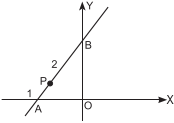
In the given figure, line APB meets the $x$-axis at A and $y$-axis at B . P is the point $(-4,2)$ and $AP : PB =1: 2$. Write down coordinates of A and B.
Image
The first two terms of a G.P. are $125$ and $25$ respectively. Find the $5^{th}$ and the $6^{th}$ terms of the G.P.