Question
Find the maximum and minimum values of the function $f(x)=\cos ^2 x+\sin x$.

Answer

Get the step-by-step solution for this question inside the Vidyadip app.

Get the answer in the app

Need a full question paper?

Generate a complete, print-ready paper with questions like this in minutes — across 16+ boards, with answer keys.
Start Generating Free

Similar questions

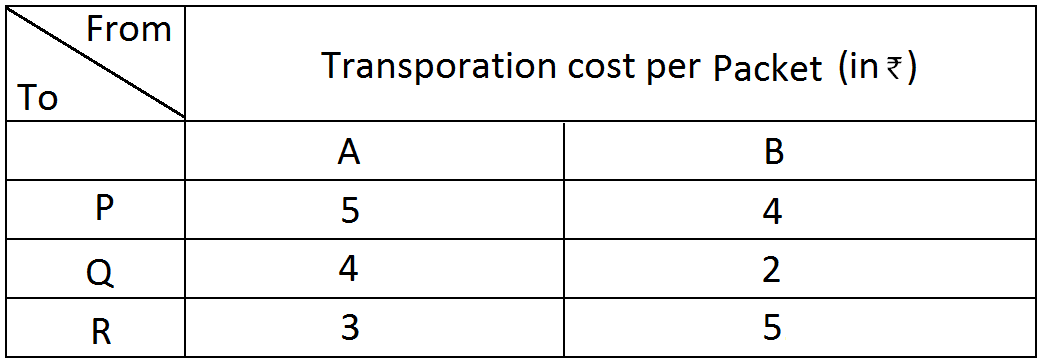
A medical company has factories at two places, A and B. From these places, supply is made to each of its three agencies situated at P, Q and R. The monthly requirements of the agencies are respectively 40, 40 and 50 packets of the medicines, while the production capacity of the factories, A and B, are 60 and 70 packets respectively. The transportation cost per packet from the factories to the agencies are given below:
How many packets from each factory be transported to each agency so that the cost of transportation is minimum? Also find the minimum cost?
A chemical company produces a chemical containing three basic elements A, B, C so that it has at least 16 liters of A, 24 liters of B and 18 liters of C. This chemical is made by mixing two compounds I and II. Each unit of compound I has 4 liters of A, 12 liters of B, 2 liters of C. Each unit of compound II has 2 liters of A, 2 liters of B and 6 liters of C. The cost per unit of compound I is ₹ 800/- and that of compound II is ₹ 640/-. Formulate the problem as L.P.P. and solve it to minimize the cost.
Find the shortest distance between the lines
$\vec{\text{r}}=6\hat{\text{i}}+2\hat{\text{j}}+2\hat{\text{k}}+\lambda\big(\hat{\text{i}}-2\hat{\text{j}}+2\hat{\text{k}}\big)$ and $\vec{\text{r}}=-4\hat{\text{i}}-\hat{\text{k}}+\mu\big(3\hat{\text{i}}-2\hat{\text{j}}+2\hat{\text{k}}\big)$
Find the equation of the plane passing through the points (-1, 2, 0), (2, 2, -1) and parallel to the line $\frac{\text{x}-1}{1}=\frac{2\text{y}+1}{2}=\frac{\text{z}+1}{-1}.$
Evaluate the following definite integrals:$\int_{0}^\limits{\infty}\frac{1}{\text{a}^2+\text{b}^2\text{x}^2} \text{ dx}$
Show that the following system of linear equation is inconsistent:
4x − 2y = 3
6x − 3y = 5
Find the particular solution of $\text{e}^{\frac{\text{dy}}{\text{dx}}}=\text{x}+1,$ that $\text{y}=3,$ when $\text{x}=0.$
Find the condition for the following set of curves to intersect orthogonally
$\frac{\text{x}^2}{\text{a}^2}-\frac{\text{y}^2}{\text{b}^2}=1\text{ and }\frac{\text{x}^2}{\text{A}^2}-\frac{\text{y}^2}{\text{B}^2}=1$
If $\vec{\text{a}}=2\hat{\text{i}}+5\hat{\text{j}}-7\hat{\text{k}},\vec{\text{b}}=-3\hat{\text{i}}+4\hat{\text{j}}+\hat{\text{k}}$ and $\vec{\text{c}}=\hat{\text{i}}-2\hat{\text{j}}-3\hat{\text{k}},$ compute $\big(\vec{\text{a}}\times\vec{\text{b}}\big)\times\vec{\text{c}}$ and $\vec{\text{a}}\times\big(\vec{\text{b}}\times\vec{\text{c}}\big)$ and verify that these are not equal.
Show that $\begin{vmatrix}\text{x}-3&\text{x}-4&\text{x}-\alpha\\\text{x}-2&\text{x}-3&\text{x}-\beta\\\text{x}-1&\text{x}-2&\text{x}-\gamma\end{vmatrix}=0,$ where $\alpha,\beta,\gamma$ are in A.P.