Question
Find the,
  1. maximum frequency, and
  2. minimum wavelength of $X-$ rays produced by $30 kV$ electrons.

Answer

Potential of the electrons $, V = 30 kV = 3 \times 10^4 V$
Hence, energy of the electrons $, E = 3 \times 10^4 eV$
Where $, e = $ Charge on an electron $= 1.6 \times 10^{-19} C$​​​​​​​
  1. Maximum frequency produced by the $X-$ rays $= v$
The energy of the electrons is given by the relation:
$E = hv$
Where,
$h =$ Planck's constant $= 6.626 \times 10-34 Js$
$\therefore\ \text{v}=\frac{\text{E}}{\text{h}}$
$=\frac{1.6\times10^{-19}\times3\times10^4}{6.626\times10^{-34}}=7.24\times10^{18}\ \text{Hz}$
Hence, the maximum frequency of $X-$ rays produced is $ 7.24 \times 10^{18} Hz$.
  1. The minimum wavelength produced by the $X-$ rays is given as:
$\lambda=\frac{\text{c}}{\text{v}}$
$=\frac{3\times10^{8}}{7.24\times10^{18}}=4.14\times10^{-11}\ \text{m}=0.0414\ \text{nm}$
Hence, the minimum wavelength of $X-$ rays produced is $ 0.0414\ nm$.

Need a full question paper?

Generate a complete, print-ready paper with questions like this in minutes — across 16+ boards, with answer keys.
Start Generating Free

Similar questions

A capacitor of unknown capacitance, a resistor of 100 $\Omega$ and an inductor of self inductance L = $( 4 /\pi^{2})$henry are connected in series to an ac source of 200V and 50 Hz. Calculate the value of the capacitance and impedance of the circuit when the current is in phase with the voltage. Calculate the power dissipated in the circuit.
Give reasons for the following:
  1. The Zener diode is fabricated by heavily doping both the p and n sides of the junction.
  2. A photodiode, when used as a detector of optical signals is operated under reverse bias.
  3. The band gap of the semiconductor used for fabrication of visible LED’s must at least be 1.8eV.
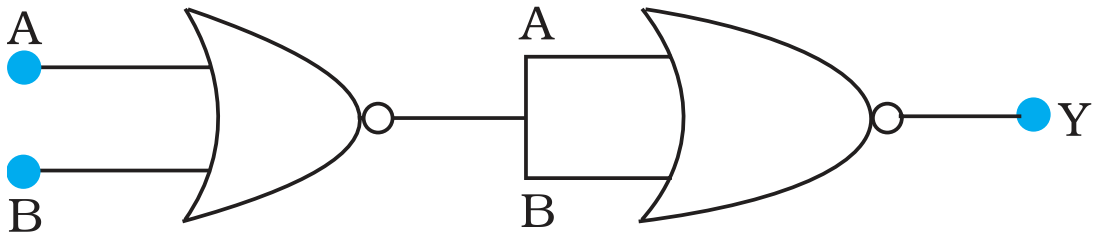
Write the truth table for circuit given in Fig. 14.47 below consisting of NOR gates and identify the logic operation (OR, AND, NOT) which this circuit is performing.
(Hint: A = 0, B = 1 then A and B inputs of second NOR gate will be 0 and hence Y=1. Similarly work out the values of Y for other combinations of A and B. Compare with the truth table of OR, AND, NOT gates and find the correct one.)
Draw the typical input and output characteristics of an $\text{n - p - n}$ transistor in $CE$ configuration. Show how these characteristics can be used to determine
$(a)$ the input resistance $(r_i),$ and
$(b)$ current amplification factor $(\beta).$
A 5.0 diopter lens forms a virtual image which is 4 times the object placed perpendicularly on the principal axis of the lens. Find the distance of the object from the lens.
In Exercise $4.11$ obtain the frequency of revolution of the electron in its circular orbit. Does the answer depend on the speed of the electron? Explain.
A wheel of mass 10kg and radius 20cm is rotating at an angular speed of 100rev/min when the motor is turned off. Neglecting the friction at the axle, calculate the force that must be applied tangentially to the wheel to bring it to rest in 10 revolutions.
  1. Describe the working of photodiode by drawing the circuit diagram.
  2. Draw the characteristics of a photodiode for different illumination intensities.
  3. Why is photodiode operated in reverse bias even though the reverse bias current is much weaker than the current in forward bias?
A straight, long wire carries a current of $20A$. Another wire carrying equal current is placed parallel to it. If the. force acting on a length of $10\ cm$ of the second wire is $2 \times 10^{-5}N,$ what is the separation between them?
A semicircular wire has a length $L$ and mass $M.A$ particle of mass $m$ is placed at the centre of the circle. Find the gravitational attraction on the particle due to the wire.