Question
Find the maximum wavelength of electromagnetic radiation which can create a hole-electron pair in germanium. The band gap in germanium is 0.65eV.

Answer

Given,
Band gap of germanium, E = 0.65eV
Wavelength of the incident radiation, $\lambda=?$
For the electron‒hole pair creation, the energy of the incident radiation should be at least equal to the band gap of the material.
So,
$\text{E}=\frac{\text{hc}}{\lambda}$
$\Rightarrow\lambda=\frac{\text{hc}}{\text{E}}=\frac{1242\text{eV}-\text{nm}}{0.65\text{eV}}$
$\Rightarrow\lambda=1910.7\times10^{-9}\text{m}$
$\Rightarrow\lambda=1.9\times10^{-5}\text{m}$

Need a full question paper?

Generate a complete, print-ready paper with questions like this in minutes — across 16+ boards, with answer keys.
Start Generating Free

Similar questions

Write a short note on 'Valves' in electronics.
An inductor-coil of inductance 17mH is constructed from r wire of length 100m and cross-sectional area a copper wire of length 100m and cross-sectional area 1mm2. Calculate the time constant of the circuit if this inductor is joined across an ideal battery. The resistivity of copper $=1.7\times10^{-8}\Omega-\text{m}.$
The separation between the consecutive dark fringes in a Young's double slit experiment is 1.0mm. The screen is placed at a distance of 2.5m from the slits and the separation between the slits is 1.0mm. Calculate the wavelength of light used for the experiment.
N small conducting liquid droplets, each of radius r, are charged to a potential V each. These droplets coalesce to form a single large drop without any charge leakage. Find the potential of the large drop.
Suppose you are told that the linear size of everything in the universe has been doubled overnight. Can you test this statement by measuring sizes with a metre stick? Can you test it by using the fact that the speed of light is a universal constant and has not changed? What will happen if all the clocks in the universe also start running at half the speed?
State Bohr’s quantisation condition of angular momentum. Calculate the shortest wavelength of the Bracket series and state to which part of the electromagnetic spectrum does it belong.
The drift current in a p-n junction is $20.0\mu\text{A}.$ Estimate the number of electrons crossing a cross-section per second in the depletion region.
  1. State Bohr postulate of hydrogen atom that gives the relationship for the frequency of emitted photon in a transition.
  2. An electron jumps from fourth to first orbit in an atom. How many maximum number of spectral lines can be emitted by the atom? To which series these lines correspond?
What is the advantage of using a polygonal mirror with larger number of faces in Michelson method of measuring the speed of light?
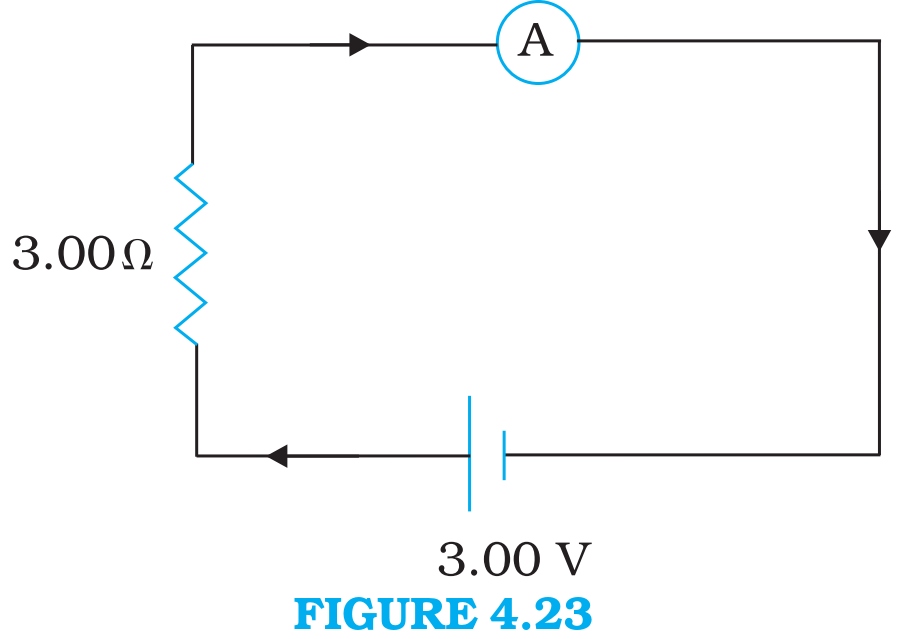
In the circuit (Fig. 4.23) the current is to be measured. What is the value of the current if the ammeter shown (a) is a galvanometer with a resistance $R_G=60.00 \Omega$; (b) is a galvanometer described in (a) but converted to an ammeter by a shunt resistance $r_s=0.02 \Omega$; (c) is an ideal ammeter with zero resistance?
Image