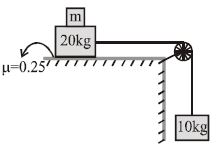
Find the minimum value of $m$ that should placed on $20\, kg$, so that system remain at rest ........ $kg$
Medium
Download our app for free and get started
$10 \mathrm{g}=\mu(\mathrm{m}+20) \mathrm{g}$
$\Rightarrow 10=0.25(\mathrm{m}+20) \Rightarrow \mathrm{m}=20 \mathrm{kg}$

Download our appand get started for free
Experience the future of education. Simply download our apps or reach out to us for more information. Let's shape the future of learning together!No signup needed.*
Similar Questions
- 1A body of mass $\mathrm{m}$ is kept on a rough horizontal surface (coefficient of friction $=\mu$ ) A horizontal force is applied on the body, but it does not move. The resultant of normal reaction and the frictional force acting on the object is given by $\mathrm{F},$ where $\mathrm{F}$ isView Solution
- 2A cyclist turns around a curve at $15\, miles/hour$. If he turns at double the speed, the tendency to overturn isView Solution
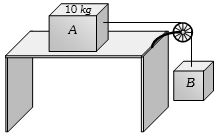
- 3If mass of $A = 10\,\,kg$, coefficient of static friction $= 0.2$, coefficient of kinetic friction = $0.2$. Then mass of $B$ to start motion isView Solution
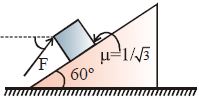
- 4The minimum value of $‘F’$ so that block is in equilibrium isView Solution
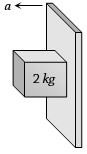
- 5A rough vertical board has an acceleration $‘a’$ so that a $2$ kg block pressing against it does not fall. The coefficient of friction between the block and the board should beView Solution
- 6A block is placed on a rough horizontal plane. A time dependent horizontal force $F = Kt$ acts on the block. Here $K$ is a positive constant. Acceleration-time graph of the block isView Solution
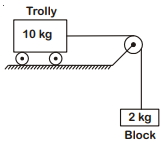
- 7Calculate the acceleration (In $m/s^{2}$) of the block and trolly system shown in the figure. The coefficient of kinetic friction between the trolly and the surface is $0.05 .\left( g =10\; m / s ^{2},\right.$ mass of the string is negligible and no other friction exists).View Solution
- 8A motor cyclist moving with a velocity of $72\, km/hour$ on a flat road takes a turn on the road at a point where the radius of curvature of the road is $20$ meters. The acceleration due to gravity is $10 m/sec^2$. In order to avoid skidding, he must not bend with respect to the vertical plane by an angle greater thanView Solution
- 9An annular ring with inner and outer radii $R_{1}$ and $R_{2}$ is rolling without slipping with a uniform angular speed. The ratio of the forces experienced by the two particles situated on the inner and outer parts of the ring, $\frac{F_{1}}{F_{2}}$ isView Solution
- 10A mass of $100\, gm$ is tied to one end of a string $2 \,m$ long. The body is revolving in a horizontal circle making a maximum of $200$ revolutions per min. The other end of the string is fixed at the centre of the circle of revolution. The maximum tension that the string can bear is .......... $N$. (approximately)View Solution