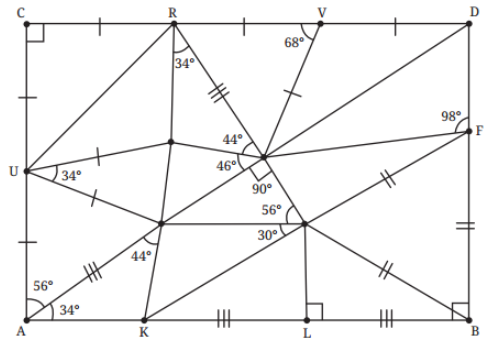
In ∆CUR
∠CUR = ∠CRU = x (say)
(∵ CU = CR)
According to the angle sum property of a triangle
x + x + 90° = 180°
⇒ 2x = 180° – 90° = 90°
⇒ x = 45°
∴ ∠CUR = ∠CRU = 45°
In ∆VRN
∠VRN = ∠VNR = a (say)
[∵ Angles opposite to equal sides are equal]
∵ VR = VN
Since the sum of the angles of a triangle is 180°.
So, a + a + 68° = 180°
⇒ 2a = 180° – 68°
⇒ 2a = 112°
⇒ a = 56°
∠VRN = ∠VNR = 56°
In ∆AUP
∠UAP = ∠UPA (∵ they are equal)
∠UPA = 56°
The sum of the angles of a triangle is 180°.
So, 56° + 56° + ∠AUP = 180°
⇒ 112° + ∠AUP = 180°
⇒ ∠AUP = 180° – 112°
⇒ ∠AUP = 68°
∆BOF is an equilateral triangle as all sides are equal.
So, OB = OF = BF
∠FOB = ∠FBO = ∠OFB = 60°
∠RVN + ∠DVN = 180°
⇒ 68° + ∠DVN = 180°
⇒ ∠DVN = 180° – 68°
⇒ ∠DVN = 112°
∠VND + ∠VDN + ∠NVD = 180°
∵ VN = VD
∴ ∠VND = ∠VDN = c
∴ c + c + 112° = 180°
⇒ 2c = 180° – 112°
⇒ 2c = 68°
⇒ c = 34°
∠VND = ∠VDN = 34°
In ∆OLB
∠OBL = 90° – 60° = 30°
∠LOB = 60° [∵ LO || BF and BO is transversal]
In ∆OPN
∠OPN + ∠PON + ∠PNO = 180°
⇒ ∠OPN + 56° + 90° = 180°
⇒ ∠OPN + 146° = 180°
⇒ ∠OPN = 180° – 146°
⇒ ∠OPN = 34°
Now, ∠APK + ∠KPO + ∠OPN = 180° [∵ Straight angle is 180°]
⇒ 44° + ∠KPO + 34° = 180°
⇒ ∠KPO = 180° – 78°
⇒ ∠KPO = 102° In ∆KPO
∠KPO + ∠POK + ∠PKO = 180°
⇒ 102° + 30° + ∠PKO = 180°
⇒ 132° + ∠PKO = 180°
⇒ ∠PKO = 180° – 132° = 48°
∠KAP + ∠KPA + ∠AKP = 180° [∵ Sum of angles of a triangle is 180°]
⇒ 34° + 44° + ∠AKP = 180°
⇒ 78° + ∠AKP = 180°
⇒ ∠AKP = 180° – 78°
⇒ ∠AKP = 102° and ∠PKO = 48°
So, ∠AKP + ∠PKO + ∠OKL = 180°
⇒ 102° + 48° + ∠OKL = 180°
⇒ 150° + ∠OKL = 180°
⇒ ∠OKL = 180° – 150°
⇒ ∠OKL = 30°
In ∆KOL
∠OKL + ∠OLK + ∠KOL = 180°
⇒ 30° + 90° + ∠KOL = 180°
⇒ ∠KOL = 180° – 120°
⇒ ∠KOL = 60°
Also, ∆OKL ≅ ∆OBL
KL = LB
∠OLK ≅ ∠OLB = 90°
Side angle side condition.