Question
Find the missing frequency p for the following frequency distribution whose mean is 28.25.
x
15
20
25
30
35
40
f
8
7
p
14
15
6

Answer

We prepare the follwoing frequency distribution table:
(xi)
(fi)
fixi
15
8
120
20
7
140
25
p
25p
30
14
420
35
15
525
40
6
240
 
$\sum\text{f}_\text{i}=50+\text{p}$
$\sum\text{f}_\text{i}\text{x}_\text{i}=14145+25\text{p}$
Mean $=\frac{\sum\text{f}_\text{i}\text{x}_\text{i}}{\sum\text{f}_\text{i}}=\frac{1445+25\text{p}}{50+\text{p}}=28.25$
$\therefore\ \frac{1445+25\text{p}}{50+\text{p}}=28.25$
$\Rightarrow1445+25\text{p}=(28.25)(50+\text{p})$
$\Rightarrow1445+25\text{p}=1412.50+28.25\text{p}$
$\Rightarrow-28.25\text{p}+25\text{p}=-1445+1412.50$
$\Rightarrow-3.25\text{p}=-32.5$
$\Rightarrow\text{p}=\frac{32.5}{3.25}=10$
$\therefore\ $the value of p = 10

Need a full question paper?

Generate a complete, print-ready paper with questions like this in minutes — across 16+ boards, with answer keys.

Start Generating Free

Similar questions

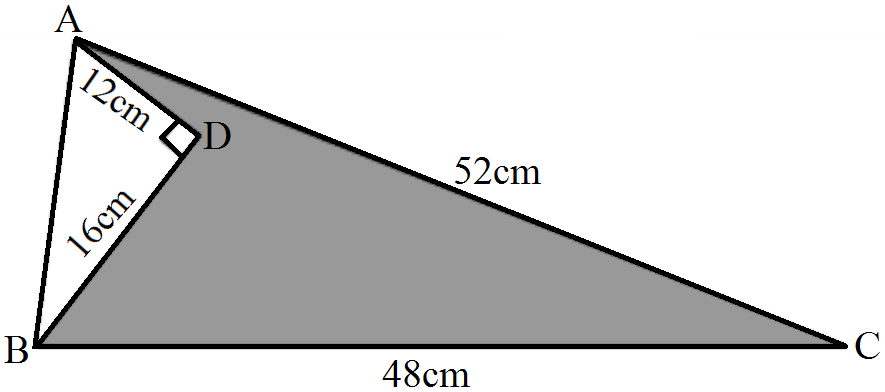
Find the area of the shaded region in the figure given below.

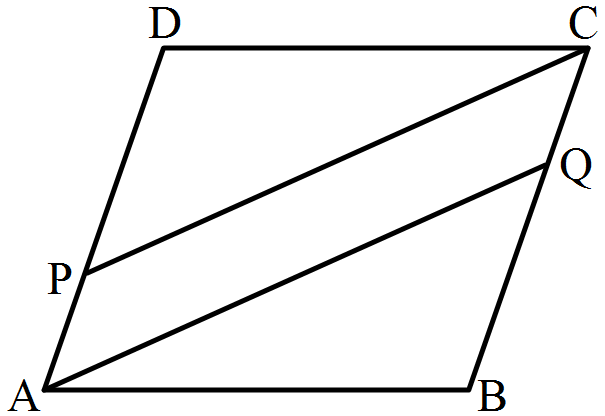
In the adjoining figure, ABCD is a parallelogram. If P and Q are points on AD and BCrespectively such that $\text{AP}=\frac{1}{2}\text{AD}$ and $\text{CQ}=\frac{1}{2}\text{BC},$ prove that AQCP is a parallelogram.

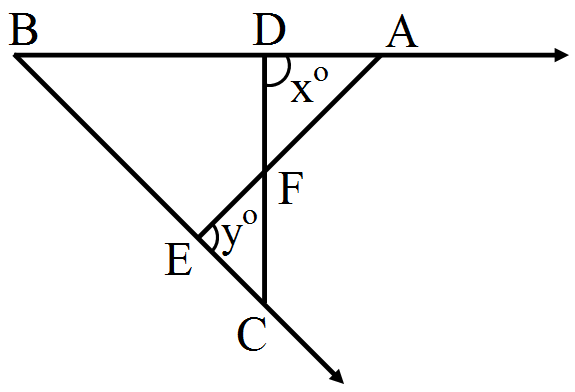
In the given figure, if x = y and AB = CB then prove that AE = CD.

Explain, by taking a suitable example, how the arithmetic mean alters by:
  1. Adding a constant k to each term.
  2. Subtracting a constant k from each term.
  3. Multiplying each term by a constant k.
  4. Dividing each term by non-zero constant k.
Find the length of a chord which is at a distance of 3cm from the centre of a circle of radius 5cm.
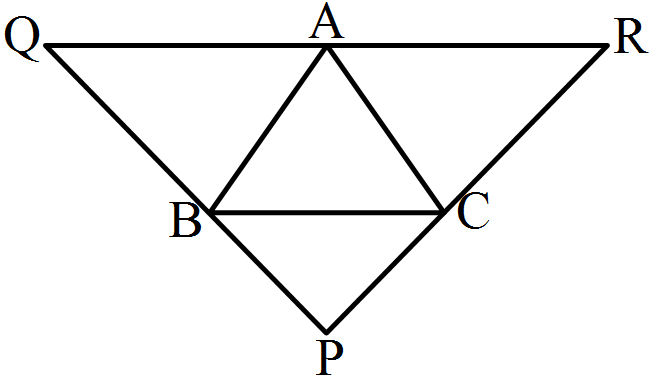
In the adjoining figure, $\triangle\text{ABC}$ is a triangle and through A, B, C, lines are drawn, parallel respectively to BC, CA and AB, intersecting at P, Q and R. Prove that the perimeter of $\triangle\text{PQR}$ is double the perimeter of $\triangle\text{ABC}.$

Calculate the area of the triangle whose sides are 18cm, 34cm, 24cm and 30cm in length. Also, find the length of the altitude corresponding to the smallest side. 
The numbers 42, 43, 44, 44, (2x + 3), 45, 45, 46, 47 have been arranged in an ascending order and their median is 45. Find the value of x. Hence, find the mode of the above data.
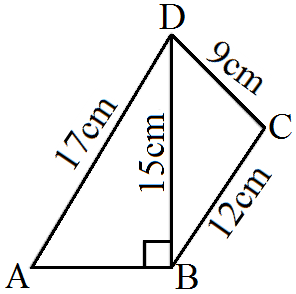
Find the perimeter and area of a qudrilateral ABCD in which BC = 12cm, CD = 9cm, BD = 15cm, DA = 17cm and $\angle\text{ABD}=90^\circ.$

An organisation selected 2400 families at random and surveyed them to determine a relationship between the income level and the number of vehicles in a family. The information gathered is listed in the table below:
Monthly income(in ₹)
Number of vehicles per family
0
1
2
3 or more
Less than ₹ 25000
10
160
25
0
 ₹ 25000 - ₹ 30000
0
305
27
2
 ₹ 30000 - ₹ 35000
1
535
29
1
 ₹ 35000 - ₹ 40000
2
469
59
25
 ₹ 40000 or more
1
579
82
88
Suppose a family is chosen at random. Find the probability that the family chosen is:
  1. Earning ₹ 25000 - ₹ 30000 per month and owning exactly 2 vehicles.
  2. Earning ₹ 40000 or more per month and owning exactly 1 vehicle.
  3. Earning less than ₹ 25000 per month and not owning any vehicle.
  4. Earning ₹ 35000 - ₹ 40000 per month and owning 2 or more vehicles.
  5. Owning not more than 1 vehicle.