Question
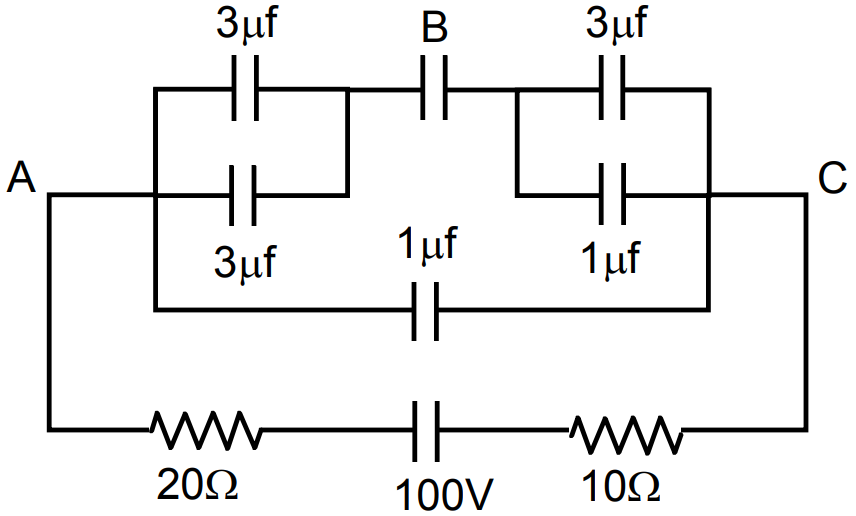
Find the potential difference between the points A and B and between the points B and C of the figure. in steady state.
Answer


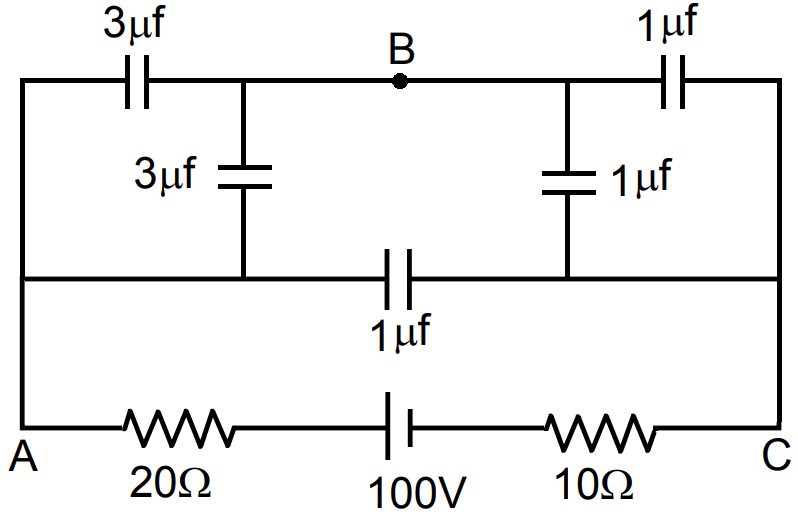
$\text{C}_\text{eq}=\big[(3\mu\text{fp}\ 3\mu\text{f})\text{s}(1\mu\text{f p}1\mu\text{f})\big]\text{p}(1\mu\text{f})$

$=\big[(3+3)\mu\text{f s}(2\mu\text{f})\big]\text{p}1\mu\text{f}$

$=\frac{3}{2}+1=\frac{5}{2}\mu\text{f}$

$\text{V}=100\text{V}$

$\text{Q}=\text{CV}=\frac{5}{2}\times100=250\mu\text{c}$

Charge stored across $1\mu\text{f}$ capacitor $=100\mu\text{C}$

Ceq between A and B is $=6\mu\text{f}=\text{C}$

Potential drop across $\text{AB}=\text{V}=\frac{\text{Q}}{\text{C}}=25\text{V}$

Potential drop across BC = 75V.

Need a full question paper?

Generate a complete, print-ready paper with questions like this in minutes — across 16+ boards, with answer keys.

Start Generating Free

Similar questions

When a dielectric is placed in an electric field, it gets polarized. The electric field in a polarized material is less than the applied field. When a paramagnetic substance is kept in a magnetic field, the field in the substance is more than the applied field. Explain the reason of this opposite behaviour.
The conduction band of a solid is partially filled at 0K. Will it be a conductor, a semiconductor or an insulator?
$\text{ }^{212}_{33}\text{Bi}$ can disintegrate either by emitting an $\alpha$-particle of by emitting a $\beta^-$-particle.
  1. Write the two equations showing the products of the decays.
  2. The probabilities of disintegration $\alpha$ and $\beta$ -decays are in the ratio $\frac{7}{13}.$ The overall half-life of 212Bi is one hour. If 1g of pure 212Bi is taken at 12.00 noon, what will be the composition of this sample at 1P.m. the same day?
  1. Draw a labelled ray diagram showing the formation of image by a compound microscope in normal adjustment. Derive the expression for its magnifying power.
  2. How does the resolving power of a microscope change when.
  1. The diameter of the objective lens is decreased,
  2. The wavelength of the incident light is increased.

Justify your answer in each case.

What will be the energy corresponding to the first excited state of a hydrogen atom if the potential energy of the atom is taken to be 10eV when the electron is widely separated from the proton? Can we still write $\text{E}_\text{n}=\frac{\text{E}_1}{\text{n}^2}?\text{ r}_\text{n}=\text{a}_0\text{n}^2?$ 
An air-filled parallel-plate capacitor is to be constructed which can store $12\mu\text{C}$ of charge when operated at 1200V. What can be the minimum plate area of the capacitor? The dielectric strength of air is 3 × 10⁶Vm-1.
For a glass prism $(\mu=\sqrt{3})$ the angle of minimum deviation is equal to the angle of the prism. Find the angle of the prism.
Repeat part (a) of problem 6 if the push is applied horizontally and not parallel to the incline.
When a metal plate is exposed to a monochromatic beam of light of wavelength 400nm, a negative potential of 1.1V is needed to stop the photocurrent. Find the threshold wavelength for the metal.
A heater coil is to be constructed with a nichrome wire $(\rho=1.0\times10^{-6}\Omega-\text{m})$which can operate at 500W when connected to a 250V supply.
  1. What would be the resistance of the coil?
  2. If the cross-sectional area of the wire 0.5mm2, what length of the wire will be needed?
  3. If the radius of each turn is 4.0mm, how many turns will be there in the coil?