Question
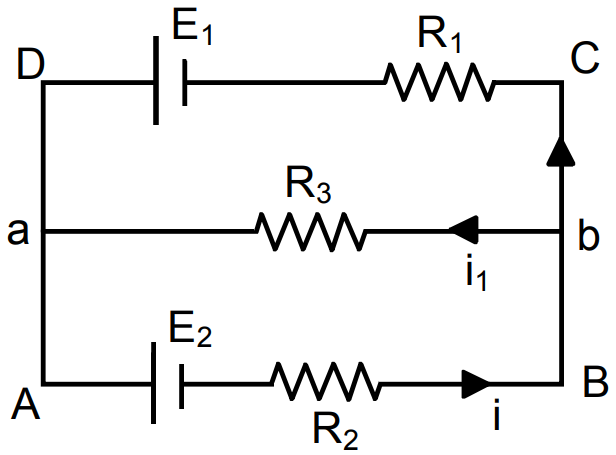
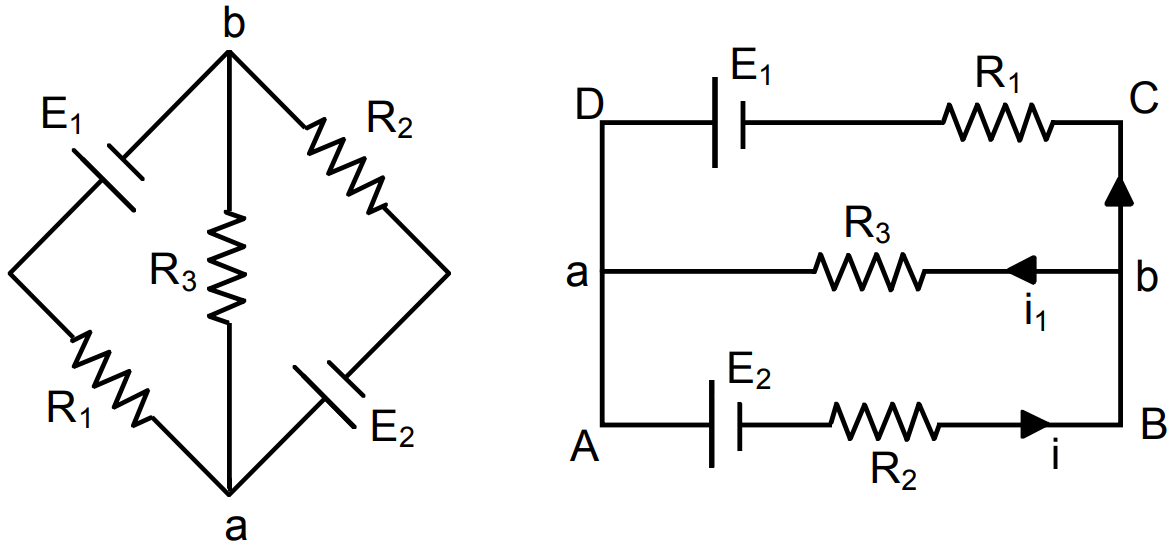
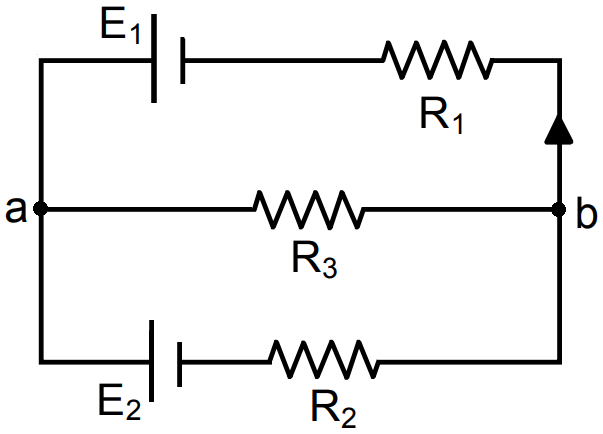
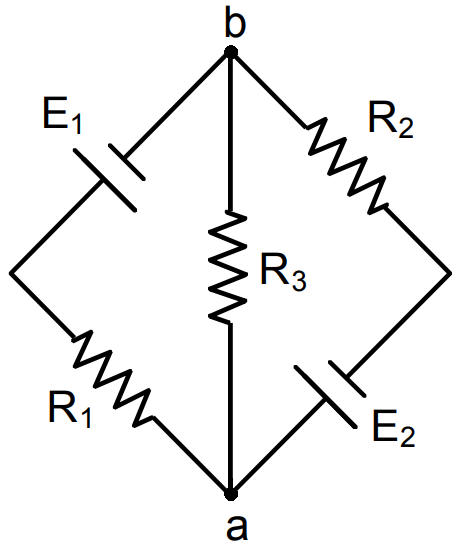
Find the potential difference $V_a - V_b$ in the circuits shown in figure.

Answer

  1. In circuit, AB ba A


$\text{E}_2+\text{iR}_2+\text{i}_1\text{R}_3=0$

In circuit, $\text{i}_1\text{R}_3+\text{E}_1-(\text{i}-\text{i}_1)\text{R}_1=0$

$\Rightarrow\text{i}_1\text{R}_3+\text{E}_1-\text{iR}_1+\text{i}_1\text{R}_1=0$

$[\text{iR}_2+\text{i}_1\text{R}_3\ \ \ \ \ \ \ \ \ \ \ \ \ \ \ \ \ \ \ \ \ \ =-\text{E}_2]\text{R}_1\\ [\text{iR}_2-\text{i}_1(\text{R}_1+\text{R}_3)\ \ \ \ \ \ \ \ \ =\text{E}_1]\text{R}_2\\\underline{\ \ \ \ \ \ \ \ \ \ \ \ \ \ \ \ \ \ \ \ \ \ \ \ \ \ \ \ \ \ \ \ \ \ \ \ \ \ \ \ \ \ \ \ \ \ \ \ \ \ \ \ \ \ \ \ \ }\\\text{iR}_2\text{R}_1+\text{i}_1\text{R}_3\text{R}_1\ \ \ \ \ \ \ \ \ \ \ \ \ =-\text{E}_2\text{R}_1\\\text{iR}_2\text{R}_1-\text{i}_1\text{R}_2(\text{R}_1+\text{R}_3)=\ \ \ \text{E}_1\text{R}_2\\\underline{ \ \ \ \ \ \ \ \ \ \ \ \ \ \ \ \ \ \ \ \ \ \ \ \ \ \ \ \ \ \ \ \ \ \ \ \ \ \ \ \ \ \ \ \ \ \ \ \ \ \ \ \ \ \ \ \ \ }$

$\text{iR}_3\text{R}_1+\text{i}_1\text{R}_2\text{R}_1+\text{i}_1\text{R}_2\text{R}_3=\text{E}_1\text{R}_2-\text{E}_1\text{R}_1$

$\Rightarrow\text{i}_1(\text{R}_3\text{R}_1+\text{R}_2\text{R}_1+\text{R}_2\text{R}_3)=\text{E}_1\text{R}_2-\text{E}_2\text{R}_1$

$\Rightarrow\text{i}_1=\frac{\text{E}_1\text{R}_2-\text{E}_2\text{R}_1}{\text{R}_3\text{R}_1+\text{R}_2\text{R}_1+\text{R}_2\text{R}_3}$

$\Rightarrow\frac{\text{E}_1\text{R}_2\text{R}_3-\text{E}_2\text{R}_1\text{R}_3}{\text{R}_3\text{R}_1+\text{R}_2\text{R}_1+\text{R}_2\text{R}_3}=\Bigg(\frac{\frac{\text{E}_1}{\text{R}_1}-\frac{\text{E}_2}{\text{R}_2}}{\frac{1}{\text{R}_2}+\frac{1}{\text{R}_1}+\frac{1}{\text{R}_3}}\Bigg)$
  1. $\therefore$ Same as a

Need a full question paper?

Generate a complete, print-ready paper with questions like this in minutes — across 16+ boards, with answer keys.
Start Generating Free

Similar questions

Write the two processes that take place in the formation of a p-n junction. Explain with the help of a diagram, the formation of depletion region and barrier potential in a p-n junction.
A solenoid of length 1.0m, radius 1cm and total turns 1000 wound on it, carries a current of 5A. Calculate the magnitude of the axial magnetic field inside the solenoid. If an electron was to move with a speed of $104ms^{–1}$ along the axis of this current carrying solenoid, what would be the force experienced by this electron?
A steel wire of original length 1m and cross-sectional area $4.00mm^2$ is clamped at the two ends so that it lies horizontally and without tension. If a load of 2.16kg is suspended from the middle point of the wire, what would be its vertical depression? Y of the steel $= 2.0 \times 10^{11}N/m^2$ Take $g = 10m/s^2.$
Is the colour of 620nm light and 780nm light same? Is the colour of 620nm light and 621nm light same? How many colours are there in white light?
A proton and an α-particle move perpendicular to a magnetic field. Find the ratio of radii of the circular paths described by them when both (i) have equal momenta, and (ii) were accelerated through the same potential difference.
An ideal gas $\Big(\frac{\text{C}_\text{P}}{\text{C}_\text{V}}=\gamma\Big)$ is taken through a process in which the pressure and the volume vary as $p = aV^b$. Find the value of b for which the specific heat capacity in the process is zero.
Estimate the number of electrons in 100g of water. How much is the total negative charge on these electrons?
  1. Define the term ‘conductivity’ of a metallic wire. Write its SI unit.
  2. Using the concept of free electrons in a conductor, derive the expression for the conductivity of a wire in terms of number density and relaxation time. Hence obtain the relation between current density and the applied electric field E.
In the relation to the photoelectric effect, write the definition of the terms 'stopping potential' and 'threshold frequency'. How are these physical quantities determined using Einstein's equation?
In a single slit diffraction experiment, when a tiny circular obstacle is placed in the path of light from a distant source, a bright spot is seen at the centre of the shadow of the obstacle. Explain why? State two points of difference between the interference pattern obtained in Young’s double slit experiment and the diffraction pattern due to a single slit.