Question
Find the potential energy of a system of four particles placed at the vertices of a square of side $l$. Also obtain the potential at the centre of the square.
Answer

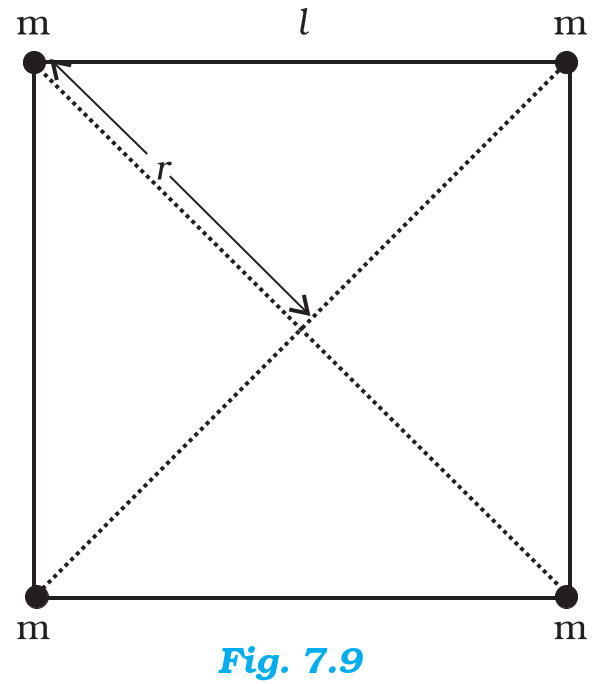
Consider four masses each of mass $m$ at the corners of a square of side $l$; See Fig. $7.9$.
We have four mass pairs at distance $l$ and two diagonal pairs at distance $\sqrt{2} t$
Hence,
$W(r)=-4 \frac{G m^2}{l}-2 \frac{G m^2}{\sqrt{2} l}$
$=-\frac{2 G m^2}{l}\left(2+\frac{1}{\sqrt{2}}\right)=-5.41 \frac{G m^2}{l}$
Image
The gravitational potential at the centre of the square $(r=\sqrt{2} l / 2)$ is
$
U(r)=-4 \sqrt{2} \frac{ Gm }{l} .
$

Need a full question paper?

Generate a complete, print-ready paper with questions like this in minutes — across 16+ boards, with answer keys.
Start Generating Free

Similar questions

A man of mass $70kg$ stands on a weighing scale in a lift which is moving. Upwards with a uniform speed of $10 ms^{-1}$.
The moment of inertia of a uniform rod of mass $0.50kg$ and length $1m$ is $0.10kg-m^2$ about a line perpendicular to the rod. Find the distance of this line from the middle point of the rod.
Two particles located at a point begin to move with velocities $4m s^{-1}$ and $1m s^{-1}$ horizontally in opposite directions. Determine the time when their velocity vectors become perpendicular. Assume that the motion takes place in a uniform gravitational field of strength g.
A cart of mass M is at rest on a frictionless horizontal surface and a pendulum bob of mass m hangs from the roof of the cart. The string breaks, the bob falls on the floor, makes several collisions on the floor and finally lands up in a small slot made in the floor. The horizontal distance between the string and the slot is L. Find the displacement of the cart during this process.
A magnifying glass is a converging lens placed close to the eye. A farsighted person uses spectacles having converging lenses. Compare the functions of a converging lens used as a magnifying glass and as spectacles.
According to Newton's third law each team pulls the opposite team with equal force in a tug of war. Why then one team wins and the other loses?
Estimate the average mass density of a sodium atom assuming its size to be about $2.5 \mathring{\text{A}}.$ (Use the known values of Avogadro’s number and the atomic mass of sodium). Compare it with the mass density of sodium in its crystalline phase: $970kg m^{–3}. $Are the two densities of the same order of magnitude? If so, why?
Draw the energy$-$distribution graph of a black body. List some salient features.
A person weighing $60 kg$ takes in $2000\ kcal$ diet in a day. If this energy were to be used in heating the person without any loss, what would be his rise in temperature? Given specific heat of human body is $0.83 \mathrm{cal} \mathrm{g}^{-1}{ }^{\circ} \mathrm{C}^{-1}$
  1. If the successive overtones of vibrating string are $280Hz$ and $350Hz$, what is the frequency of the fundamental note?
  2. If the amplitude of a sound wave is tripled, by how many $dB$ will the intensity level increases?