Question
Find the radius of a circle whose perimeterter and are are numerically equal.

Answer

let r be the radius of a circle.Then, area of a circle $=\pi\text{r}^2$
Perimeter of a circle $=2\pi\text{r}$
It is given that,
Area of a circle = Perimeter of a circle
$\Rightarrow\pi\text{r}^2=2\pi\text{r}$
$\Rightarrow \text{r}= 2 \text{ units}$

Need a full question paper?

Generate a complete, print-ready paper with questions like this in minutes — across 16+ boards, with answer keys.

Start Generating Free

Similar questions

Prove that the centre of a circle touching two intersecting lines lies on the angle bisector of the lines.
The given distribution shows the number of runs scored by some top batsmen of the world in one-day international cricket matches.
Runs scored Number of batsmen
3000-4000 4
4000-5000 18
5000-6000 9
6000-7000 7
7000-8000 6
8000-9000 3
9000-10000 1
10000-11000 1
Find the mode of the data.
In an isosceles triangle $ABC$, if $AB = AC = 13\ cm$ and the altitude from $A$ on $BC$ is $5cm$, find $BC.$
The following is the cummulative frequency distribution (of less than type) of $1000$ persons each of age $20$ years and above. Determine the mean age.
Age below (in year):
$30$
$40$
$50$
$60$
$70$
Number of persons:
$100$
$220$
$350$
$750$
$950$
Find the $HCF$ of $1008$ and $1080$ by prime factorization method.
A rectangular water tank of base 11m × 6m contains water upto a height of 5m. If the water in the tank is transferred to a cylindrical tank of radius 3.5m, find the height of the water level in the tank.
In a $\triangle\text{ABC,D}\ \text{and E}$ are points on the sides AB and AC respectively such that DE || BC.
If $\frac{\text{AD}}{\text{BD}}=\frac{4}{5}$ and EC = 2.5cm, find AE.
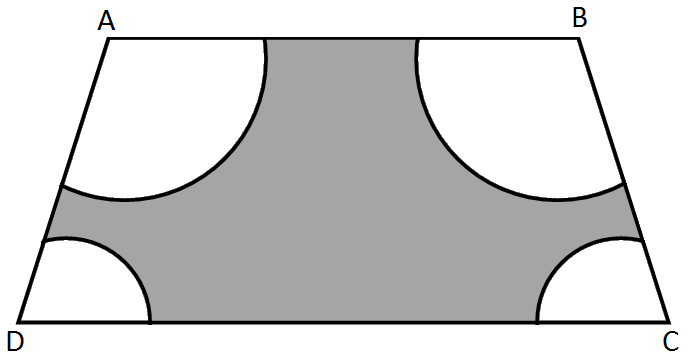
In the given figure, ABCD is a trapezium with $\text{AB}||\text{DC},\text{AB}=18\text{cm}$ DC = 32cm and the distance between AB and DC is 14cm. Circles of equal radii 7cm with centres A, B, C and D have been drawn. Then find the area of the shaded region.$\Big(\text{Use }\pi=\frac{22}{7}\Big)$
Find the roots of the following quadratic equations by the factorisation method:
$3\sqrt{2}\text{x}^2-5\text{x}-\sqrt{2}=0.$
Find the value of a and b for which the following systems of linear equations has an infinite number of solutions:
$(a - 1)x + 3y = 2,$
$6x + (1 - 2b)y = 6$