Question
Find the sum of the series whose $n^{th}$​​​​​​​ term is:$(2n - 1)^2$​​​​​​​

Answer

$T_n = (2n - 1)^2$
Let $S_n$​​​​​​​ be the sum of $n$ terms of the given series.
Now,
$\text{S}_\text{n}=\sum\limits^{\text{n}}_{\text{k}=1}\text{T}_\text{k}$
$\Rightarrow\text{S}_\text{n}=\sum\limits^{\text{n}}_{\text{k}=1}(2\text{k}-1)^2$
$\Rightarrow\text{S}_\text{n}=\sum\limits^{\text{n}}_{\text{k}=1}(4\text{k}^2+1-4\text{k})$
$\Rightarrow\text{S}_\text{n}=4\sum\limits^{\text{n}}_{\text{k}=1}\text{k}^2+\sum\limits^{\text{n}}_{\text{k}=1}1-4\sum\limits^{\text{n}}_{\text{k}=1}\text{k}$
$\Rightarrow\text{S}_\text{n}=\frac{4\text{n}(\text{n}+1)(2\text{n}+1)}{6}+\text{n}-\frac{4\text{n}(\text{n}+1)}{2}$
$\Rightarrow\text{S}_\text{n}=\frac{\text{n}(\text{n}+1)}{2}\Big[\frac{4(2\text{n}+1)}{3}-4\Big]+\text{n}$
$\Rightarrow\text{S}_\text{n}=\frac{\text{n}(\text{n}+1)}{2}\Big(\frac{8\text{n}+4-12}{3}\Big)+\text{n}$
$\Rightarrow\text{S}_\text{n}=\frac{\text{n}(\text{n}+1)}{2}\Big(\frac{8\text{n}-8}{3}\Big)+\text{n}$
$\Rightarrow\text{S}_\text{n}=4\text{n}(\text{n}+1)\Big(\frac{\text{n}-1}{3}\Big)+\text{n}$
$\Rightarrow\text{S}_\text{n}=\frac{\text{n}}{3}(4\text{n}^2+4\text{n}-4\text{n}-4+3)$
$\Rightarrow\text{S}_\text{n}=\frac{\text{n}}{3}(4\text{n}^2-1)$
$\Rightarrow\text{S}_\text{n}=\frac{\text{n}}{3}(2\text{n}-1)(2\text{n}+1)$

Need a full question paper?

Generate a complete, print-ready paper with questions like this in minutes — across 16+ boards, with answer keys.
Start Generating Free

Similar questions

Evaluate the following limit:
$\lim\limits_{\text{x}\rightarrow5}\frac{\text{x}-5}{\sqrt{6\text{x}-5}-\sqrt{4\text{x}+5}}$
For any two sets A and B, prove the following:
$\text{A}\cap\text{(A}'\cup\text{B})=\text{A}\cap\text{B}$
If the line $2x - y + 1 = 0$ touches the circle at the point $(2, 5)$ and the centre of the circle lies on the line $x + y - 9 = 0.$ Find the equation of the circle.
Solve the following equations by using determinant
$\frac{1}{x}+\frac{1}{y}+\frac{1}{z}=-2, \frac{1}{x}-\frac{2}{y}+\frac{1}{z}=3, \frac{2}{x}-\frac{1}{y}+\frac{3}{2}=-1$
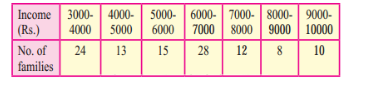
Calculate the coefficient of variation for the data given below:

Image

A candidate is required to answer 7 questions out of 12 questions which are divided into two groups, each containing 6 questions. He is not permitted to attempt more than 5 questions from either group. In how many ways can he choose the 7 questions?
Find the equation of circle passing through the point of intersection of the lines x + 3y = 0 and 2x – 7y = 0 and whose centre is the point of intersection of lines x + y + 1 = 0 and x – 2y + 4 = 0.
Let P(n) be the statement: $2^{\text{n}}\geq3\text{n}.$ If p(r) is true, Show that p(r + 1) is true. Do you conclude that p(n) is true for all $\text{n}\in\text{N}$?
Life of bulbs produced by two factories $A$ and $B$ are given below:
Length of life $($in hours$):$ $550-650$ $650-750$ $750-850$ $850-950$ $950-1050$
Factory $A: ($Number of bulbs$)$ $10$ $22$ $52$ $20$ $16$
Factory $B: ($Number of bulbs$)$ $8$ $60$ $24$ $16$ $12$
The bulbs of which factory are more consistent from the point of view of length of life?
Solve the following quadratic equations:

$x^2-(5-i) x+(18+i)=0$