Question
Find the sum of the series whose $n^{th}$ term is:
$2n^3 + 3n^2 - 1$

Answer

We have,
$T_n = n^3 - 3n$
Let $S_n$ denote the sum of n terms of the series whose nth term is $T_n.$ Then,
Now,
$\text{S}_\text{n}=\sum\limits^{\text{n}}_{\text{k}=1}\text{T}_\text{k}$
$\Rightarrow\text{S}_\text{n}=\sum\limits^{\text{n}}_{\text{k}=1}(\text{k}^3-3^\text{k})$
$\Rightarrow\text{S}_\text{n}=\sum\limits^{\text{n}}_{\text{k}=1}\text{k}^3-\sum\limits^{\text{n}}_{\text{k}=1}3\text{k}$
$\Rightarrow\text{S}_\text{n}=\frac{\text{n}^2(\text{n}+1)^2}{4}-(3+3^2+3^3+3^4+\ ....\ +3^{\text{n}})$
$\Rightarrow\text{S}_\text{n}=\frac{\text{n}^2(\text{n}+1)^2}{4}-\Big[\frac{3(3^{\text{n}}-1)}{3-1}\Big]$
$\Rightarrow\text{S}_\text{n}=\frac{\text{n}^2(\text{n}+1)^2}{4}-\frac{3}{2}(3^{\text{n}}-1)$

Need a full question paper?

Generate a complete, print-ready paper with questions like this in minutes — across 16+ boards, with answer keys.
Start Generating Free

Similar questions

What is the smallest positive integer n for which $(1+\text{i})^{2\text{n}}=(1-\text{i})^{2\text{n}} \ ?$
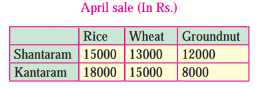
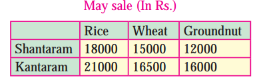
Two farmers Shantaram and Kantaram cultivate three crops rice, wheat, and groundnut. The sale (in Rupees) of these crops by both the farmers for the month of April and may 2008 is given below,

Image

Image

Find

(i) the total sale in rupees for two months of each farmer for each crop.

(ii) the increase in sales from April to May for every crop of each farmer.

Find the mean and variance of frequency distribution given below:
$x_i$ $1\leq\text{x}<3$ $3\leq\text{x}<5$ $5\leq\text{x}<7$ $7\leq\text{x}<10$
$f_1$ 6 4 5 1
Prove that:
$(\text{A}\cap\text{B})\times\text{C}=(\text{A}\times\text{C})\cap(\text{B}\times\text{C})$
Show that the straight lines $L_1 = (b + c)x + ay + 1 = 0, L_2 = (c + a)x + by + 1 = 0$ and $L_3 = (a + b)x + cy + 1 = 0$ are concurrent.
Let $\text{f}:[0,\infty)\rightarrow\text{R}$ and $\text{g}:\text{R}\rightarrow\text{R}$ be defined by $\text{f(x)}=\sqrt{\text{x}}$ and g(x) = x. Find f + g, g - g, fg and $\frac{\text{f}}{\text{g}}$
Prove the following by the principle of mathematical induction:
$1 + 2 + 2^2 + ... + 2^n = 2^{n+1} - 1$ for all $\text{n}\in\text{N}.$
Evaluate the following limit:
$\lim\limits_{\text{x}\rightarrow0}\frac{\sqrt{1+\text{x}^2}-\sqrt{1-\text{x}^2}}{\text{x}}$
Prove that the following sets of three lines are concurrent:
3x - 5y - 11 = 0, 5x + 3y - 7 = 0 and x + 2y = 0
Evaluate the following limits:
$\lim _{x \rightarrow \frac{\pi}{4}}\left[\frac{\sqrt{2}-\cos x-\sin x}{(4 x-\pi)^2}\right]$