Question
Find the sum on which the difference between the simple interest and compound interest at the rate of $8\%$ per annum compounded annually would be $Rs. 64$ in $2$ years.

Answer

Let $Rs, X$ be the $\sum.$
Simple Interest$(I)=\frac{X \times 8 \times 2}{100}=0.16 X$
Compound interest
For $1^{\text {st }}$ year :
$P=\text { Rs. } X_i R=8 \%$ and $T=1$
$\Rightarrow$ Interest $(I)=\frac{X \times 8 \times 1}{100}=0.08 X$
And amount $=\text{₹}(x+0.08 x)$
$\text { = ₹ } 1.08 \mathrm{x}$
For $2^{\text {nd }}$ year :
$P=\text { Rs. } X+\text { Rs. } 0.08 X=\text { Rs. } 1.08 X$
$ \Rightarrow \text { Interest }(I)=\frac{1.08 \mathrm{X} \times 8 \times 1}{100}=0.0864 X$
And, amount $=\text{₹}(1.08 x+0.0864 x)$
$=\text{₹} 1.1664 \mathrm{x}$
So,
$C.I =$ Amount $-p$
$=\text{₹}(1.1664 x-x)$
$=\text{₹} 0.1664 x$
The difference between the simple interest and compound interest at the rate of $8 \%$ per annum compounded annually should be $Rs. 64$ in $2$ years.
$\text{₹} 0.1664 x-\text{₹} 0.16 x=\text{₹} 64$
$\text{₹} 0.0064 \mathrm{x}=\text{₹} 64$
$x=\text{₹} 10000$
Therefore, the $\sum$ is $\text{₹ 10,000}$.

Need a full question paper?

Generate a complete, print-ready paper with questions like this in minutes — across 16+ boards, with answer keys.
Start Generating Free

Similar questions

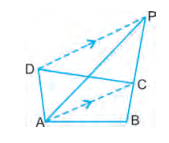
In the given figure, ABCD is a quadrilateral. A line through D , parallel to AC , meets BC produced in P .
Prove that : ar $(\triangle ABP )=$ ar (quad. ABCD $)$.
Image
In parallelogram $\text{ABCD},$ the bisector of angle $A$ meets $DC$ at $P$ and $AB = 2 AD$.Prove that:$(i) \ BP$ bisects angle $B.(ii)$ Angle $APB = 90^o.$
If $A=30^{\circ}$, prove that :
(i) $\sin 2 A=\frac{2 \tan A}{\left(1+\tan ^2 A\right)}$ (ii) $\cos 2 A=\left(\frac{1-\tan ^2 A}{1+\tan ^2 A}\right)$
Given: $mx + ny = p$ and $y = ax + b$. Find $x$ in terms of $m, n, p, a$ and $b.$
On a certain sum of money, invested at the rate of $10$ percent per annum compounded annually, the interest for the first year plus the interest for the third year is $Rs. 2,652$. Find the $\sum.$
Two right$-$angled triangles $ABC$ and $ADC$ have the same base $AC$. If $BC = DC$, prove that $AC$ bisects $\angle BCD.$
Find the amount and compound interest on $Rs.50000$ onn $1 \frac{1}{2}$ years at $8\% p.a.$ compounded half$-$yearly.
The internal length, breadth, and height of a box are $30 \ cm, 24 \ cm,$ and $15 \ cm$. Find the largest number of cubes which can be placed inside this box if the edge of each cube is$(i) 3 \ cm (ii) 4 \ cm (iii) 5 \ cm$
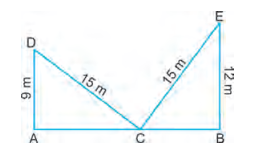
A ladder 15 m long reaches a window which is 9 m above the ground on one side of the street. Keeping its foot at the same point, the ladder is turned to the other side of the street to reach a window 12 m high. Find the width of the street.
Image
Make $R_2$ the subject of formula $R^2=4 \pi\left(R_1{ }^2-R_2{ }^2\right)$