Question
Find the third proportion to the following :
$(x - y)$ and $m (x - y)$

Answer

Let z be lhe third proportion
$(x - y) : m (x - y) : : m (x - y) : z$
$\Rightarrow (x -y) x z - m(x - y) x m (x - y)$
$\Rightarrow   (x - y) z = m^2 (x - y)^2$
$\Rightarrow   z = m^2 (x - y)$
The third proportion is $m^2 (x - y) . $

Need a full question paper?

Generate a complete, print-ready paper with questions like this in minutes — across 16+ boards, with answer keys.
Start Generating Free

Similar questions

Given $A=\left[\begin{array}{cc}-3 & 6 \\ 0 & -9\end{array}\right]$ and $A^t$ is its transpose matrix. Find $\frac{1}{2} A-\frac{1}{3} A^t$
Prove the following identitie:
$sec^4A (1 - \sin^4A) - 2 \tan^2A = 1$
Determine whether the given quadratic equations have equal roots and if so, find the roots:
$x^2+ 2x + 4 = 0$
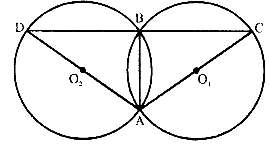
In the figure, AB is a common chord of the two circles. If AC and AD are diameters; prove that D, B, and C are in a straight line. $O_1$ and $O_2$ are the centers of two circles.
Given below is a page from the passbook of a saving bank account that Mr. Sharma has with SBI. If the bank gives interest at 6%pa, find
The interest she gets at the end of March.
Date Particulars Withdrawls Deposite Balance
05.01.08 By cash 15500.00 15500.00
10.01.08 To cheque 4800.00 10700.00
15.02.08 To cheque 5300.00 5400.00
08.03.08 By cash 19200.00 24600.00
17.03.08 To cheque 7400.00 32000.00
Prove that $(\sin \theta + cosec \theta )^2 + (\cos \theta + sec \theta )^2 = 7 + \tan^2\theta + \cot^2\theta .$
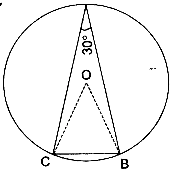
In the given Figure, ABC is a triangle in which ∠BAC = 30°. Show that BC is the radius of the circumcircle of A ABC, whose center is O.

Construct a frequency distribution table for each of the following distributions
Marks (less than) 0 10 20 30 40 50 60 70 80 90 100
Cumulative frequency 0 7 28 54 71 84 105 147 180 196 200
The line segment joining the points $(5, −4)$ and $(2, 2)$ is divided by the points Q in the ratio $1:2$ Does the line $x – 2y = 0$ contain Q?
Find the equation of the line through the points A(-1,3) and B(0,2). Hence, show that the pointA,B and C (1,1) are collinear.