Question
Find the time required for $50\,Hz$ alternating current to change its value from zero to maximum value.

Answer

${\rm{I}} = {{\rm{I}}_0}{\rm{sin}}\,\omega {\rm{t}}$

$ \Rightarrow  \mathrm{I}_{0}=\mathrm{I}_{0} \sin \omega \mathrm{t} $

$ \Rightarrow  \sin \omega \mathrm{t}=1 $

$\Rightarrow  \omega \mathrm{t}=\frac{\pi}{2}$

$ \Rightarrow  2 \pi \mathrm{ft}=\frac{\pi}{2}  \Rightarrow \mathrm{t}=\frac{1}{200}, \mathrm{s}=5 \mathrm{\,ms} $

Need a full question paper?

Generate a complete, print-ready paper with questions like this in minutes — across 16+ boards, with answer keys.

Start Generating Free

Similar questions

Two bodies starts moving from same point along a straight line with velocities $v_1=6 \,m / s$ and $v_2=10 \,m / s$, simultaneously. After what time their separation becomes $40 \,m$ is ........ $s$
In an interference pattern the $(n + 4)^{th}$ blue bright fringe and $n^{th}$ red bright fringe are formed at the same spot. If red and blue light have the wavelength of $7800\,\mathop A\limits^o $ and $5200\,\mathop A\limits^o $ then value of $n$ should be
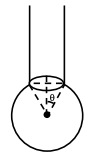
When liquid medicine of density $\rho$ is to be put in the eye, it is done with the help of a dropper. As the bulb on the top of the dropper is pressed, a drop forms at the opening of the dropper. We wish to estimate the size of the drop. We first assume that the drop formed at the opening is spherical because that requires a minimum increase in its surface energy. To determine the size, we calculate the net vertical force due to the surface tension $T$ when the radius of the drop is $\mathrm{R}$. When the force becomes smaller than the weight of the drop, the drop gets detached from the dropper.

$1.$ If the radius of the opening of the dropper is $\mathrm{r}$, the vertical force due to the surface tension on the drop of radius $R$ (assuming $\mathrm{r} \ll R$ ) is

$(A)$ $2 \pi r T$ $(B)$ $2 \pi R T$ $(C)$ $\frac{2 \pi r^2 T}{R}$ $(D)$ $\frac{2 \pi R^2 T}{r}$

$2.$ If $\mathrm{r}=5 \times 10^{-4} \mathrm{~m}, \rho=10^3 \mathrm{~kg} \mathrm{~m}^{-3}, \mathrm{~g}=10 \mathrm{~m} / \mathrm{s}^2, \mathrm{~T}=0.11 \mathrm{Nm}^{-1}$, the radius of the drop when it detaches from the dropper is approximately

$(A)$ $1.4 \times 10^{-3} \mathrm{~m}$ $(B)$ $3.3 \times 10^{-3} \mathrm{~m}$

$(C)$ $2.0 \times 10^{-3} \mathrm{~m}$ $(D)$ $4.1 \times 10^{-3} \mathrm{~m}$

$3.$ After the drop detaches, its surface energy is

$(A)$ $1.4 \times 10^{-6} \mathrm{~J}$ $(B)$ $2.7 \times 10^{-6} \mathrm{~J}$

$(C)$ $5.4 \times 10^{-6} \mathrm{~J}$ $(D)$ $8.1 \times 10^{-6} \mathrm{~J}$

Give the answer question $1,2$ and $3.$
If induction of magnetic field at a point is $B$ and energy density is $U$ then which of the following graphs is correct
Which of following gives Fehling solution test ?
The equation of stationary wave along a stretched string is given by $y = 5\sin \frac{{\pi x}}{3}\cos 40\pi t$, where $x $ and $y$ are in $cm$ and $t$ in second. The separation between two adjacent nodes is..... $cm$
According to Bohr's theory the radius of electron in an orbit described by principal quantum number $n$ and atomic number $Z$ is proportional to
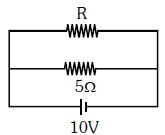
The power dissipated in the circuit shown in the figure is $30\, Watts$. The value of $R$ is ............. $\Omega$
Needles $N_I,  N_2$ and $N_3$ are made of a ferromagnetic, a paramagnetic and a diamagnetic substance respectively. A magnet when brought close to them will
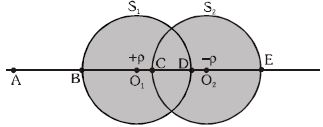
Two uniform spherical charge regions $S_1$ and $S_2$ having positive and negative charges overlap each other as shown in the figure. Point $O_1$ and $O_2$ are their centres and points $A, B, C$ and $D$ are on the line joining centres $O_1$ and $O_2$. Electric field from $C$ to $D$