MCQ
Find the time required for $50\,Hz$ alternating current to change its value from zero to maximum value.
  • A
    $2.5\, s$
  • B
    $5\, s$
  • C
    $2.5\, ms$
  • $5\, ms$

Answer

Correct option: D.
$5\, ms$
d
${\rm{I}} = {{\rm{I}}_0}{\rm{sin}}\,\omega {\rm{t}}$

$ \Rightarrow  \mathrm{I}_{0}=\mathrm{I}_{0} \sin \omega \mathrm{t} $

$ \Rightarrow  \sin \omega \mathrm{t}=1 $

$\Rightarrow  \omega \mathrm{t}=\frac{\pi}{2}$

$ \Rightarrow  2 \pi \mathrm{ft}=\frac{\pi}{2}  \Rightarrow \mathrm{t}=\frac{1}{200}, \mathrm{s}=5 \mathrm{\,ms} $

Need a full question paper?

Generate a complete, print-ready paper with questions like this in minutes — across 16+ boards, with answer keys.
Start Generating Free

Similar questions

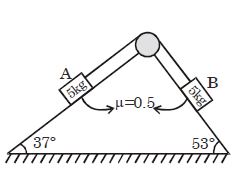
In the shown arrangement if $f_A\,,\, f_B$ and $T$ be the frictional forces on $A$ Block, $B$ Block and tension in the string respectively, then their values are
To a germanium sample, traces of gallium are added as an impurity. The resultant sample would behave like
Two coils of self inductance $100\,mH$ and $400\,mH$ are placed very close to each other. Find the maximum mutual inductance between the two when $8\,A$ current passes through them.......$mH$
Which of the following is the correct device for the detection of thermal radiation
The kinetic energy $k$ of a particle moving along a circle of radius $R$ depends on the distance covered $s$ as $k = a{s^2}$ where $a$ is a constant. The force acting on the particle is
A cylindrical block of wood of base area $30\ cm^2$ , floats in a liquid of density $900\ kg/m^3$ . The block is depressed lightly and then released. The time period of the resulting oscillations of the block is equal to that of spring with block of same mass, then spring constant is equal to ........ $N/m$
What is the power gain in $CE$ amplifier, where input resistance is $3\,k\Omega $ and load resistance $24\,k\Omega $ , given  $\beta  = 20$ ?
Two point masses of $0.3\ kg$ and $0.7\ kg$ are fixed at the ends of a rod of length $1.4\ m$  and of negligible mass. The rod is set rotating about an axis perpendicular  to its length with a uniform angular speed. The point on the rod through which the axis should pass in order that the work required for rotation of the rod is minimum is located at a distance of  
Match List$-I$ with List$-II$

List$-I$ List$-II$
$(a)$ $h$ (Planck's constant) $(i)$ $\left[ M L T ^{-1}\right]$
$(b)$ $E$ (kinetic energy) $(ii)$ $\left[ M L ^{2} T ^{-1}\right]$
$(c)$ $V$ (electric potential) $(iii)$ $\left[ M L ^{2} T ^{-2}\right]$
$(d)$ $P$ (linear momentum) $( iv )\left[ M L ^{2} I ^{-1} T ^{-3}\right]$

Choose the correct answer from the options given below

The area of a cross-section of steel wire is $0.1\,\,cm^2$ and Young's modulus of steel is $2\,\times \,10^{11}\,\,N\,\,m^{-2}.$  The force required to stretch by $0.1\%$ of its length is ......... $N$.