Question
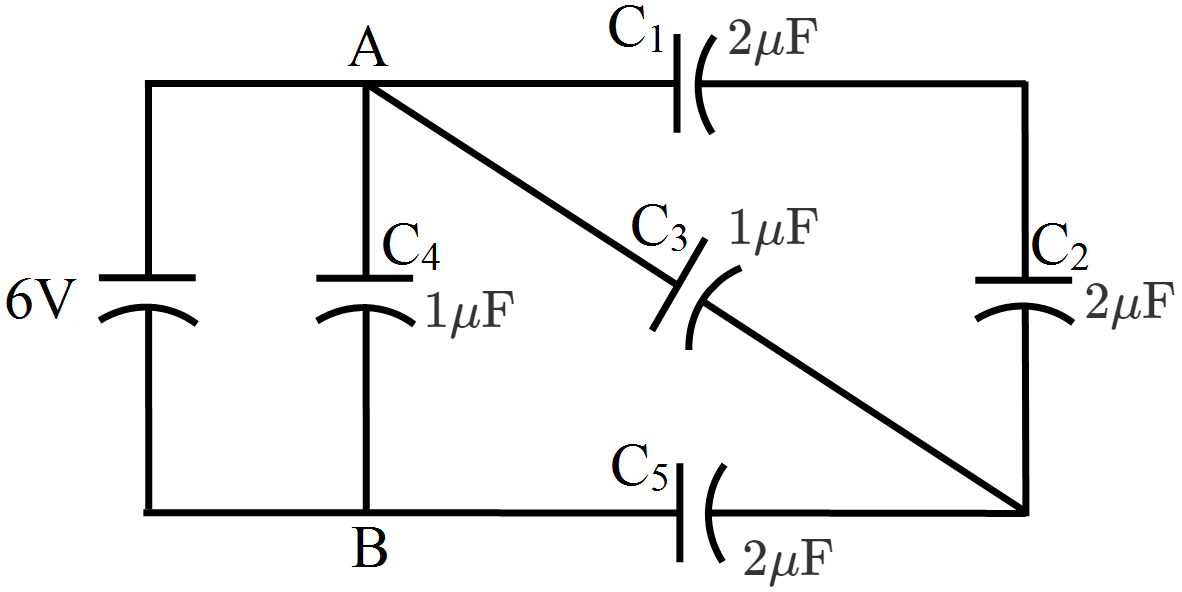
Find the total energy stored in the capacitors in the given network.

Answer

The equivalent capacitance of $C_1$ and $C_2$ in series $,\text{C}'=\frac{\text{C}_1\text{C}_2}{\text{C}_2+\text{C}_2}=\frac{2\times2}{2+2}=1\mu\text{F}$
$C\ ′$ is in parallel with $C_3,$ so equivalent capacitance of $C_1, C_2$ and $C_3$ is:$\text{C}''=1+1=2\mu\text{F}$
$C\ ''$ is in series with $C_4$; their equivalent capacitance $, \text{C}''=\frac{\text{C}_4\text{C}}{\text{C}_4+\text{C}''}=\frac{2\times2}{2+2}=1\mu\text{F}$
This is in parallel with $C_5$ ;
So equivalent capacitance across $AB$ is $\text{C}_{\text{AB}}=1+1=2\mu\text{F},$ Energy stored $\text{V}'=\frac{1}{2}\text{C}_{\text{AB}}\text{V}^2=\frac{1}{2}\times2\times10^{-6}\times(6)^2=36\times10^{-6}\text{J}$

Need a full question paper?

Generate a complete, print-ready paper with questions like this in minutes — across 16+ boards, with answer keys.
Start Generating Free

Similar questions

Consider the situation of the previous question from a frame moving with a speed v0 parallel to the initial velocity of the block.
  1. What are the initial and final kinetic energies?
  2. What is the work done by the kinetic friction?
Define electric current and current density. By giving an example prove that electric current is a scalar quantity but not a vector quantity. Explain electric current in any conductor.
How is a galvanometer converted into a voltmeter and an ammeter? Draw the relevant diagrams and find the resistance of the arrangement in each case. Take resistance of galvanometer as G.
Write and explain Kirchhoff's loop rule
  1. A giant refracting telescope at an observatory has an objective lens of focal length $15 m$. If an eyepiece of focal length $1.0 \ cm$ is used, what is the angular magnification of the telescope?
  2. If this telescope is used to view the moon, what is the diameter of the image of the moon formed by the objective lens? The diameter of the moon is $3.48 \times 10^{6 }m,$ and the radius of lunar orbit is $3.8 \times 10^{8 }m.$
State the Lenz's law regarding electromagnetic induction. This law is based on the conservation law of which quantity?
A horizontal conducting wire of length 2 m oriented in east-west direction is falling down with a speed of 5 m/s perpendicular to the horizontal component of earth's magnetic field of $0.3 \times 10^{-4} T.$ Calculate the instantaneous value of induced emf across the ends of the wire.
What is the true weight of an object in a geostationary satellite that weighed exactly $10.0N$ at the north pole?
A wire of length l carries a current i long the x-axis. A magnetic field exists, which is given $\overrightarrow{\text{B}}=\text{B}_0(\overrightarrow{\text{i}}+\overrightarrow{\text{j}}+\overrightarrow{\text{k}})\text{T}.$ Find the magnitude of the magnetic force acting on the wire.
Consider the situation of the previous problem. Suppose the production of the radioactive isotope starts at $t = 0$. Find the number of active nuclei at time $t$.
The sunlight reaching Earth has maximum electric field of $810\ Vm^{-1}.$ What is the maximum magnetic field in this light?