Question
Find the trigonometric functions of : 270°
Answer

Image
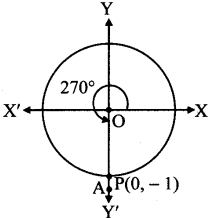
Angle of measure $270^{\circ}$ :
Let $m \angle X O A=270^{\circ}$
Its terminal arm (ray $O A)$ intersects the standard unit circle at $P(0,-1)$.
$ x=0 \text { and } y=-1$
$\sin 270^{\circ}=y=-1$
$\cos 270^{\circ}=x=0$
$\tan 270^{\circ}=\frac{y}{x} $
$=-\frac{1}{0}$, which is not defined
$\operatorname{cosec} 270^{\circ}=\frac{1}{y}$
$=\frac{1}{-1}=-1$
$\sec 270^{\circ}=\frac{1}{x}$
$=\frac{1}{0}$, which is not defined
$\cot 270^{\circ}=\frac{x}{y}=\frac{0}{-1}=0$

Need a full question paper?

Generate a complete, print-ready paper with questions like this in minutes — across 16+ boards, with answer keys.

Start Generating Free

Similar questions

Express $\left\{(x, y) / x^2+y^2=100\right.$, where $\left.x, y \in W\right\}$ as a set of ordered pairs.
Solve the following inequalities and write the solution set using interval notation.$x^2-x>20$
Simplify the following and express in the form a + ib:
$\frac{\sqrt{5}+\sqrt{3 i}}{\sqrt{5}-\sqrt{3} i}$
If ω is the complex cube root of unity, show that

$(2-\omega)\left(2-\omega^2\right)=7$

Check the injectivity and surjectivity of the following functions.

$f: R \rightarrow R$ given by $f(x)=x^2$

If $\text{a}\cos2\text{x}+\text{b}\sin2\text{x}=\text{c}$ has $\alpha$ and $\beta$ as its roots, then prove that,
$\tan(\alpha+\beta)=\frac{\text{b}}{\text{a}}$
The numbers 1, 2, 3 and 4 are written separately on four slips of paper. The slips are then put in a box and mixed thoroughly. A person draws two slips from the box, one after the other, without replacement.
Describe the following events:
A = The number on the first slip is larger than the one on the second slip.
B = The number on the second slip is greater than 2.
C = The sum of the numbers on the two slips is 6 or 7.
D = The number on the second slips is twice that on the first slip.
Which pair(s) of events is (are) mutually exclusive?
Prove that:
$\cos55^\circ+\cos65^\circ\cos175^\circ=0$
If one invests Rs. 10,000 in a bank at a rate of interest 8% per annum, how long does it

take to double the money by compound interest? $\left[(1.08)^5=1.47\right]$

Without expanding, find the value of

$(x+1)^4-4(x+1)^3(x-1)+6(x+1)^2(x-1)^2-4(x+1)(x-1)^3+(x-1)^4$