MCQ
Find the true statement.
  • A
    An electron will not lose energy when jumping from the $1^{\text {st }}$ orbit to the $3^{\text {rd }}$ orbit.
  • B
    An electron will not give energy when jumping from the $1^{\text {st }}$ orbit to the $3^{\text {rd }}$ orbit.
  • C
    An electron will release energy when jumping from the $1^{\text {st }}$ orbit to the $3^{\text {rd }}$orbit.
  • An electron will absorb energy when jumping from the $1^{\text {st }}$ orbit to the $3^{\text {rd }}$ orbit.
Answer

Correct option: D.
An electron will absorb energy when jumping from the $1^{\text {st }}$ orbit to the $3^{\text {rd }}$ orbit.
Only by absorbing energy, an electron will be able to jump from the first orbit to the third orbit in the atomic spectrum.

Need a full question paper?

Generate a complete, print-ready paper with questions like this in minutes — across 16+ boards, with answer keys.

Start Generating Free

Similar questions

Which is reverse biased diode
 
For a medium, refractive indices for violet, red and yellow are $1.62, 1.52$ and $ 1.55$ respectively, then dispersive power of medium will be
Susceptibility is positive for:
A capacitor of capacitance $500\mu\text{F}$ is connected to a battery through a $10\text{k}\Omega$ resistor. The charge stored in the capacitor in the first $5s$ is larger than the charge stored in the next:
The dispersive powers of crown and flint glasses are $0.02$ and $0.04$ respectively. In an achromatic combination of lenses the focal length of flint glass lens is $40 cm.$ The focal length of crown glass lens will be.......$cm$
At the first minimum adjacent to the central maximum of a single-slit diffraction pattern, the phase difference between the Huygen's wavelet from the edge of the slit and the wavelet from the midpoint of the slit is 
The susceptibility of a paramagnetic material is $99$ . The permeability of the material in $Wb / A - m$ is : [Permeability of free space $\left.\mu_{0}=4 \pi \times 10^{-7} Wb / A -m\right]$
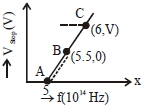
Given figure shows few data points in a photo electric effect experiment for a certain metal. The minimum energy for ejection of electron from its surfface is$.......eV$

(Plancks constant $\left. h =6.62 \times 10^{-34}\, J . s \right)$

Light waves are:
When green light is incident on the surface of metal, it emits photo-electrons but there is no such emission with yellow colour light. Which one of the colour can produce emission of photo-electrons