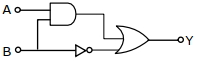
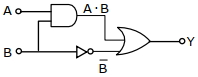
- A
$A$ $B$ $Y$ $0$ $0$ $0$ $0$ $1$ $1$ $1$ $0$ $0$ $1$ $1$ $1$ - ✓
$A$ $B$ $Y$ $0$ $0$ $1$ $0$ $1$ $0$ $1$ $0$ $1$ $1$ $1$ $1$ - C
$A$ $B$ $Y$ $0$ $0$ $0$ $0$ $1$ $0$ $1$ $0$ $0$ $1$ $1$ $1$ - D
$A$ $B$ $Y$ $0$ $0$ $0$ $0$ $1$ $1$ $1$ $0$ $1$ $1$ $1$ $1$

| $A$ | $B$ | $Y$ |
| $0$ | $0$ | $0$ |
| $0$ | $1$ | $1$ |
| $1$ | $0$ | $0$ |
| $1$ | $1$ | $1$ |
| $A$ | $B$ | $Y$ |
| $0$ | $0$ | $1$ |
| $0$ | $1$ | $0$ |
| $1$ | $0$ | $1$ |
| $1$ | $1$ | $1$ |
| $A$ | $B$ | $Y$ |
| $0$ | $0$ | $0$ |
| $0$ | $1$ | $0$ |
| $1$ | $0$ | $0$ |
| $1$ | $1$ | $1$ |
| $A$ | $B$ | $Y$ |
| $0$ | $0$ | $0$ |
| $0$ | $1$ | $1$ |
| $1$ | $0$ | $1$ |
| $1$ | $1$ | $1$ |
| $A$ | $B$ | $Y$ |
| $0$ | $0$ | $1$ |
| $0$ | $1$ | $0$ |
| $1$ | $0$ | $1$ |
| $1$ | $1$ | $1$ |
| $A$ | $B$ | $Y$ |
| $0$ | $0$ | $1$ |
| $0$ | $1$ | $0$ |
| $1$ | $0$ | $1$ |
| $1$ | $1$ | $1$ |

Generate a complete, print-ready paper with questions like this in minutes — across 16+ boards, with answer keys.
$V_x=V_0 \sin \omega t$ $V_y=V_0 \sin \left(\omega t+\frac{2 \pi}{3}\right) \text { and }$ $V_z=V_0 \sin \left(\omega t+\frac{4 \pi}{3}\right)$
An ideal voltmeter is configured to read rms value of the potential difference between its terminals. It is connected between points $\mathrm{X}$ and $\mathrm{Y}$ and then between $\mathrm{Y}$ and $\mathrm{Z}$. The reading(s) of the voltmeter will be
$[A]$ $\mathrm{V}_{\mathrm{XY}}^{\mathrm{mms}}=\mathrm{V}_0 \sqrt{\frac{3}{2}}$
$[B]$ $\mathrm{V}_{\mathrm{YZ}}^{\mathrm{mms}}=\mathrm{V}_0 \sqrt{\frac{1}{2}}$
$[C]$ $\mathrm{V}_{\mathrm{XY}}^{\mathrm{mms}}=\mathrm{V}_0$
$[D]$ independent of the choice of the two terminals
$N$ of electrostatic force due to the other two charges.