Question
Find the values of 'a' for which hte function $\text{f}(\text{x})=\sin\text{x}-\text{a}\text{x}+4$ is increasing function on R.

Answer

$\text{f}(\text{x})=\sin\text{x}-\text{a}\text{x}+4$
$\text{f}'(\text{x})=\cos\text{x}-\text{a}$
Given: f(x) is increasing on R.
$\Rightarrow\text{f}'>\cos\text{x}-\text{a}$
$\Rightarrow\cos\text{x}>\text{a}$
We know,
$\cos\text{x}\geq-1,\forall\ \text{x}\in\text{R}$
$\Rightarrow\text{a}<-1$
$\Rightarrow\text{a}\in(-\infty,-1)$

Need a full question paper?

Generate a complete, print-ready paper with questions like this in minutes — across 16+ boards, with answer keys.
Start Generating Free

Similar questions

Check whether the relation R defined on the set A = {1, 2, 3, 4, 5, 6} as R = {(a, b): b = a + 1} is reflexive, symmetric or transitive.
Evaluate the following integrals:
$=\int\frac{\sin\text{x}}{(1+\cos\text{x})^2}\text{dx}$
Let the $p.m.f.$ of $r.v. X$ be $P(x)\left\{\begin{array}{l}\frac{3-x}{10}, \text { for } x=-1,0,1,2 \\ 0, \text { otherwise }\end{array}\right.$ Calculate $E(X)$ and Var$(X)$
Write the normal form of the equation of the plane 2x - 3y + 6z + 14 = 0
Let $A = R_0 \times R,$ where $R_0$ denote the set of all non-zero real numbers. $A$ binary operation $'⊙'$ is defined on $A$ as follows:
$(a, b) ⊙ (c, d) = (ac, bc + d)$ for all $(a, b), (c, d) \in R_0 \times R.$
Show that $'⊙'$ is commutative and associative on $A.$
Let A = [-1, 1]. Then, discuss whether the following functions from A to itself are one-one, onto or bijective:
g(x) = |x|
Evaluate the following definite integrals:$\int_{0}^\limits{1}\Big(\text{xe}^{2\text{x}}+\sin\frac{\pi\text{x}}{2}\Big)\text{dx}$
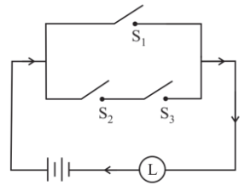
Express the following circuits in the symbolic form of logic and writ the input-output table.Image
Find the points o local maxima or local minima, if any, of the following functions, using the first derivatives test. Also, find the local maximum or local minimum values, as the case may be:
$\text{f}'(\text{x})=\text{x}^{3}(2\text{x}-1)^{3}$
Find the points o local maxima or local minima, if any, of the following functions, using the first derivatives test. Also, find the local maximum or local minimum values, as the case may be:
$\text{f}(\text{x})=\text{x}\sqrt{1-\text{x}}, \text{x}\geq0$