Question
Find the vector equation of the following planes in non-parametric form.
$\vec{\text{r}}=(\lambda-2\mu)\hat{\text{i}}+(3-\mu)\hat{\text{j}}+(2\lambda+\mu)\hat{\text{k}}$
Answer

The given equation of the plane is,
$\vec{\text{r}}=(\lambda-2\mu)\hat{\text{i}}+(3-\mu)\hat{\text{j}}+(2\lambda+\mu)\hat{\text{k}}$
$\Rightarrow\vec{\text{r}}=(0\hat{\text{i}}+3\hat{\text{j}}+0\hat{\text{k}})+\lambda(\hat{\text{i}}+0\hat{\text{j}}+2\hat{\text{k}})+\mu(-2\hat{\text{i}}-\hat{\text{j}}+\hat{\text{k}})$
We know that equation $\vec{\text{r}}=\vec{\text{a}}+\lambda\vec{\text{b}}+\mu\vec{\text{c}} $ represents a plane passing through a point whose position vector is $\vec{\text{a}}$ and parallel to t.
Here, $\vec{\text{a}}=0\hat{\text{i}}+3\hat{\text{j}}+0\hat{\text{k}},\vec{\text{b}}=\hat{\text{i}}+0\hat{\text{j}}+2\hat{\text{k}},\hat{\text{c}}=-2\hat{\text{i}}-\hat{\text{j}}+\hat{\text{k}}$
Normal vector, $\vec{\text{n}}=\vec{\text{b}}\times\vec{\text{c}}$
$=\begin{vmatrix}\hat{\text{i}}&\hat{\text{j}}&\hat{\text{k}}\\1&0&2\\-2&-1&1\end{vmatrix}$
$=2\hat{\text{i}}-5\hat{\text{j}}-\hat{\text{k}}$
The vector equation of the plane in scalar product form is,
$\vec{\text{r}}\cdot\vec{\text{n}}=\vec{\text{a}}\cdot\vec{\text{n}}$
$\Rightarrow\vec{\text{r}}\cdot(2\hat{\text{i}}-5\hat{\text{j}}-\hat{\text{k}})=(0\hat{\text{i}}+3\hat{\text{j}}+0\hat{\text{k}})(2\hat{\text{i}}-5\hat{\text{j}}-\hat{\text{k}})$
$\Rightarrow\vec{\text{r}}\cdot(2\hat{\text{i}}-5\hat{\text{j}}-\hat{\text{k}})=0-15+0$
$\Rightarrow\vec{\text{r}}\cdot(2\hat{\text{i}}-5\hat{\text{j}}-\hat{\text{k}})+15=0$

Need a full question paper?

Generate a complete, print-ready paper with questions like this in minutes — across 16+ boards, with answer keys.

Start Generating Free

Similar questions

Show that the line whose vector equation is $\vec{\text{r}}=2\hat{\text{i}}+5\hat{\text{j}}+7\hat{\text{k}}+\lambda(\hat{\text{i}}+3\hat{\text{j}}+4\hat{\text{k}})$ is parallel to the plane whose vector equation is $\vec{\text{r}}\cdot(\hat{\text{i}}+\hat{\text{j}}-\hat{\text{k}})=7$ Also, find the distance between thetm.
Find the angle between the following pairs of lines:$\frac{5-\text{x}}{-2}=\frac{\text{y}+3}{1}=\frac{1-\text{z}}{3}$ and $\frac{\text{x}}{3}=\frac{1-\text{y}}{-2}=\frac{\text{z}+5}{-1}$
If $\text{A}=\begin{bmatrix}1&2&2\\2&1&2\\2&2&1\end{bmatrix},$ then prove that $A^2 - 4A - 5I = 0.$
Find the equations of the tangent and the normal to the following curves at the indicated points.
$y = x^4 - 6x^3 + 13x^2 - 10x + 5$ at $x = 1$
A line passes through (3, -1, 2) and is perpendicular to lines

$\bar{r}=(\hat{i}+\hat{j}-\hat{k})+\lambda(2 \hat{i}-2 \hat{j}+\hat{k})$ and $\bar{r}=(2 \hat{i}+\hat{j}-3 \hat{k})+\mu(\hat{i}-2 \hat{j}+2 \hat{k})$. Find its equation.

Prove that a quadrilateral is a parallelogram if and only if its diagonals bisect each other.
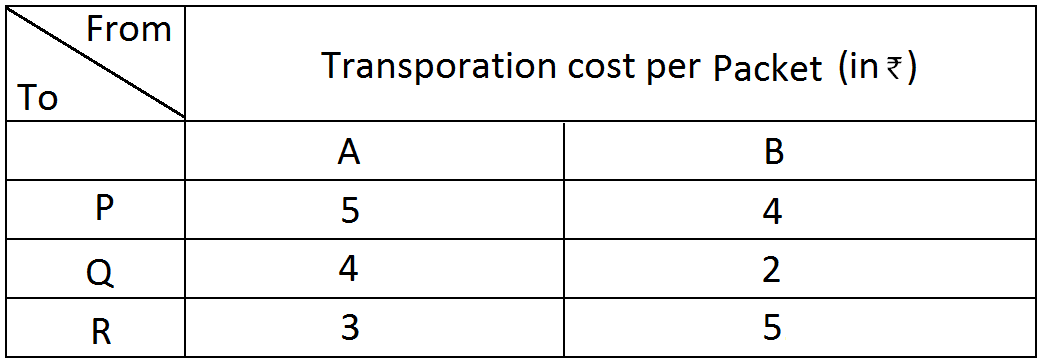
A medical company has factories at two places, A and B. From these places, supply is made to each of its three agencies situated at P, Q and R. The monthly requirements of the agencies are respectively 40, 40 and 50 packets of the medicines, while the production capacity of the factories, A and B, are 60 and 70 packets respectively. The transportation cost per packet from the factories to the agencies are given below:
How many packets from each factory be transported to each agency so that the cost of transportation is minimum? Also find the minimum cost?
Find the point on the curve $y^2= 4x$ which is nearest to the point $(2, -8).$
Form the differential equation corresponding to $\text{y}=\text{e}^{\text{mx}}$ by eliminating m.
If $(\sin\text{x})^{\text{y}}=\text{x}+\text{y},$ prove that $\frac{\text{dy}}{\text{dx}}=\frac{1-(\text{x}+\text{y})\text{y}\cot\text{x}}{(\text{x}+\text{y})\log\sin\text{x}-1}$