MCQ
Find the velocity of image with respect to mirror.
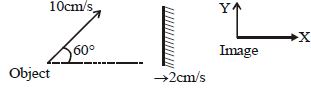
  • A
    $ - i + 5\sqrt 3 \hat j$
  • $ - 3i + 5\sqrt 3 \hat j$
  • C
    $ - i + 5 \hat j$
  • D
    $ - 3i + 5 \hat j$

Answer

Correct option: B.
$ - 3i + 5\sqrt 3 \hat j$
b
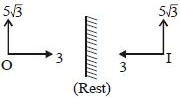
${\overrightarrow {\rm{v}} _{{\rm{om}}}} =  + 3\widehat {\rm{i}} + 5\sqrt {3\widehat j} $

w.r.t. mirror

${\overrightarrow {\rm{v}} _{{\rm{Im}}}} =  - 3\widehat {\rm{i}} + 5\sqrt {3\widehat {\rm{j}}} $
Need a full question paper?

Generate a complete, print-ready paper with questions like this in minutes — across 16+ boards, with answer keys.
Start Generating Free

Similar questions

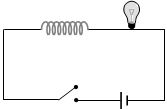
In the following circuit, the bulb will become suddenly bright if
A charged particle is moving in a uniform magnetic field in a circular path. Radius of circular path is $R$. When energy of particle is doubled, then new radius will be
A $210$ meter long train is moving due North at a of $25\,m/s$. A small bird is flying due South a little above the train with speed $5\,m/s$. The time taken by the bird to cross the train is........$s$
A heavy mass is attached to a thin wire and is whirled in a vertical circle. The wire is most likely to break
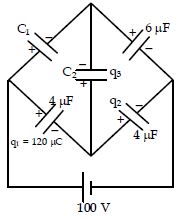
In the circuit shown, $q_2$ and $q_3$ are respectively (Initially all capacitors are uncharged)
Given that $\overrightarrow A + \overrightarrow B + \overrightarrow C= 0$ out of three vectors two are equal in magnitude and the magnitude of third vector is $\sqrt 2 $ times that of either of the two having equal magnitude. Then the angles between vectors are given by
In the following transitions, which one has higher frequency
A small telescope has an objective lens of focal length 140 cm and an eyepiece of focal length 5.0 cm . The magnifying power of the telescope for viewing distant objects when the final image is formed at the least distance of distinct vision $(=25 cm)$ is:
Two cells, $e.m.f.$ of each is $E$ and internal resistance $r$ are connected in parallel between the resistance $R$. The maximum energy given to the resistor will be, only when
The string of a simple pendulum is replaced by a uniform rod of length $L$ and mass $M$. If the mass of the bob of the pendulum is $m$, then for small oscillations its time period would be (assume radius of bob $r << L$)