MCQ
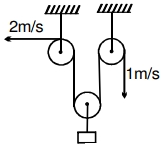
Find the velocity of the hanging block if the velocities of the free ends of the rope are as indicated in the figure.
  • $\frac{3}{2}\,m / s \uparrow$
  • B
    $\frac{3}{2}\,m / s \downarrow$
  • C
    $\frac{1}{2}\,m / s \uparrow$
  • D
    $\frac{1}{2}\,m / s \downarrow$

Answer

Correct option: A.
$\frac{3}{2}\,m / s \uparrow$
a
From constrained

$+2-v_B-v_B+1=0$

$v_B=\frac{3}{2}\,m / s \uparrow$

Need a full question paper?

Generate a complete, print-ready paper with questions like this in minutes — across 16+ boards, with answer keys.

Start Generating Free

Similar questions

Two blocks of mass $2\ kg$ and $1\ kg$ are connected by an ideal spring on a rough surface. The spring in unstreched. Spring constant is $8\ N/m$ . Coefficient of friction is  $μ = 0.8$ . Now block $2\ kg$ is imparted a velocity $u$ towards $1\ kg$ block. Find the maximum value of velocity $'u'$ of block $2\ kg$ such that block of $1\ kg$ mass never move is
A body $A$ is projected upwards with a velocity of $98\,m/s$. The second body $B$ is projected upwards with the same initial velocity but after $4 \,sec$. Both the bodies will meet after...........$sec$
Imagine $a$ situation in which the horizontal surface of block $M_0$ is smooth and its vertical surface is rough with $a$ coefficient of friction $\mu$ In above problem, the value $(s)$ of $F$ for which $M$ and $m$ are stationary with respect to $M_0 mg$
A ring and a disc are initially at rest, side by side, at the top of an inclined plane which makes an angle $60^{\circ}$ with the horizontal. They start to roll without slipping at the same instant of time along the shortest path. If the time difference between their reaching the ground is $(2-\sqrt{3}) / \sqrt{10} \mathrm{~s}$, then the height of the top of the inclined plane, in metres, is. . . . . . Take $g=10 \mathrm{~m} \mathrm{~s}^{-2}$.
A ball is released from certain height. It loses $50\%$ of its kinetic energy on striking the ground. It will attain a height again equal to
A particle moving in a circle of radius $R$ with uniform speed takes time $\mathrm{T}$ to complete one revolution. If this particle is projected with the same speed at an angle $\theta$ to the horizontal, the maximum height attained by it is equal to $4 R$. The angle of projection $\theta$ is then given by :
Two soap bubbles $\mathrm{A}$ and $\mathrm{B}$ are kept in a closed chamber where the air is maintained at pressure $8 \mathrm{~N} / \mathrm{m}^2$. The radii of bubbles $\mathrm{A}$ and $\mathrm{B}$ are $2 \mathrm{~cm}$ and $4 \mathrm{~cm}$, respectively. Surface tension of the soap-water used to make bubbles is $0.04 \mathrm{~N} / \mathrm{m}$. Find the ratio $n_{\mathrm{B}} / n_{\mathrm{A}}$, where $n_{\mathrm{A}}$ and $n_{\mathrm{B}}$ are the number of moles of air in bubbles $\mathrm{A}$ and $\mathrm{B}$, respectively. [Neglect the effect of gravity.]
A force $(\vec F) = 3\hat i + c\hat j + 2\hat k$ acting on a particle causes a displacement: $(\vec s)\, = - 4\hat i + 2\hat j + 3\hat k$ in its own direction. If the work done is $6\,J,$ then the value of $'c'$is
When two waves with same frequency and constant phase difference interfere,
$0.08 \mathrm{~kg}$ air is heated at constant volume through $5^{\circ} \mathrm{C}$. The specific heat of air at constant volume is $0.17 \mathrm{kcal} / \mathrm{kg}^{\circ} \mathrm{C}$ and $\mathrm{J}=4.18$ joule $/ \mathrm{cal}$. The change in its internal energy is approximately.