Question
Find the zeroes of the following polynomials by factorisation method and verify the relations between the zeroes and the coefficients of the polynomials:
$2\text{s}^2-(1+2\sqrt{2})\text{s}+\sqrt{2}$.
Answer

Let $\text{f}(\text{s})=2\text{s}^2-(1+2\sqrt{2})\text{s}+\sqrt{2}$
$=2\text{s}^2-\text{s}+2\sqrt{2}\text{ s}+\sqrt{2}$
$=\text{s}(2\text{s}-1)-\sqrt{2}(2\text{s}-1)$
$=(2\text{s}-1)(\text{s}-\sqrt{2})$
So, the value of $2\text{s}^2-(1+2\sqrt{2})\text{s}+\sqrt{2}$ is zero when $2\text{s}-1=0$ or $\text{s}-\sqrt{2} = 0,$
i.e., when $\text{s}=\frac{1}{2}$ or $\text{s}=\sqrt{2}$
So, the zeroes of $2\text{s}^2-(1+2\sqrt{2})\text{s}+\sqrt{2}$ are $\frac{1}{2}$ and $\sqrt{2}$
$\therefore\ \text{Sum of zeroes}=\frac{1}{2}+\sqrt{2}=\frac{1+2\sqrt{2}}{2}=\frac{-[-(1+2\sqrt{2})]}{2}$
$=\frac{\text{(Coefficient of s)}}{\text{(Coefficient of s)}^2}$
and $\text{product of zeroes}=\frac{1}{2}.\sqrt{2}=\frac{1}{\sqrt{2}}=\frac{\text{Constant term}}{\text{Coefficient of s}^2}$
Hence, verified the relations between the zeroes and the coefficients of the polynomial.

Need a full question paper?

Generate a complete, print-ready paper with questions like this in minutes — across 16+ boards, with answer keys.

Start Generating Free

Similar questions

A card is drawn at random from a well-shuffled deck of playing deck of playing cards. Find the probability that the card drawn is:
  1. A card of spades or an ace.
  2. A red king.
  3. either a king or a queen.
  4. neither a king nor a queen.
An aeroplane is flying at a height of 300m above the ground. Flying at this height the angles of depression on from the two aeoplane of two points on both banks of a river in opposite directions are 45° and 60° respectively. Find the width of the river. $\big[\text{Use}\sqrt{3}=1.732\big]$
It is given that -1 is one of the zeros of the polynomial $x^3 + 2x^2 - 11x - 12$. Find all the given zeros of the given polynomial.
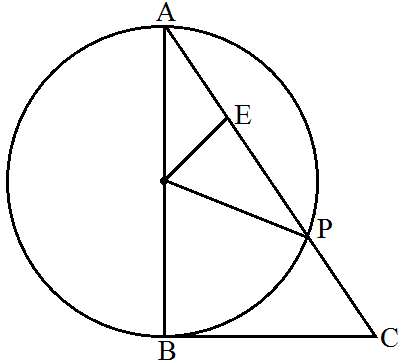
In the figure, BC is a tangent to the circle with centre O. OE bisects AP. Prove that $\triangle\text{AEO}\sim\triangle\text{ABC}.$
The areas of two similar triangles are $169 cm^2$ and $121 cm^2$ respectively. If the longest side of the larger triangle is 26 cm , find the longest side of the smaller triangle.
If a square is inscribed in a circle, find the ratio of the area of the circle and the square.
Find the lenght of a diagonal of a rectangle whose adjacent side are 30cm and 16cm.
The $26^{th}, 11^{th}$​​​​​​​ and last term of an A.P. are 0, 3 and $-\frac{1}{5},$ respectively. Find the common difference and the number of terms.
If $3\tan\theta=4,$ show that $\frac{(4\cos\theta-\sin\theta)}{(2\cos\theta+\sin\theta)}=\frac45.$
For what value of $k, (4 - k)x^2 + (2k + 4) x + (8k + 1) = 0$, is a perfect square.