Question
Find three consecutive integers such that their sum is 78.

Answer

Sum of three consecutive numbers = 78
Let first number = x
Then second number = x + 1
and third number = x + 2
Then x + x+1+x + 2 = 78
⇒ 3x + 3 = 78
⇒ 3x = 78 – 3 = 75
$\Rightarrow x=\frac{75}{3}=25$
∴ First number=25
Second number = 25 + 1 = 26
and third number = 26 + 1 = 27
Then the three required numbers are 25, 26, 27

Need a full question paper?

Generate a complete, print-ready paper with questions like this in minutes — across 16+ boards, with answer keys.
Start Generating Free

Similar questions

When Ajit travelled 15 km, he found that one-fourth of his journey was still left. What was the full length of the journey?
A man walks a distance of $5 km$ in 2 hours. Then he goes in a bus to a nearby town, which is $40 km$, in further 2 hours. From there, he goes to his office in an autorickshaw, a distance of $5 km$, in $\frac{1}{2}$ hour. What was his average speed during the whole journey?
The number of animals in five villages are as follows:
VillageABCDE
No. of. animals16024018080120
Prepare a pictograph of these animals using one symbol to represent 20 animals.
A line segment AP stands at point P of a straight line BC such that ∠APB = 5x – 40° and ∠APC = .x+ 10°; find the value of x and angle APB.
Evaluate:
$3 \frac{5}{6}-1 \frac{4}{15}-\left(3 \frac{2}{9}-1 \frac{3}{5}\right)$
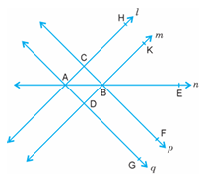
Look at the adjoining figure carefully and name :
Image
(i) all pairs of parallel lines;
(ii) all pairs of intersecting lines and their points of intersection;
(iii) all sets of collinear points;
(iv) concurrent lines and their points of concurrence;
(v) one set of three non-collinear points.
Multiply and then evaluate:
$(x^2 – y)$ and $(xy – y^2);$ when $x = 1$ and $y = 2.$
For the following raw data, form a discrete frequency distribution:
30, 32, 32, 28, 34, 34, 32, 30, 30, 32, 32, 34, 30, 32, 32,  28, 32, 30, 28, 30, 32, 32, 30, 28 and 30.
Angles of a quadrilateral are (4x)°, 5(x+2)°, (7x – 20)° and 6(x+3)°. Find :
(i) the value of x.
(ii) each angle of the quadrilateral.
Construct traingle ABC, when : AB = 6 cm, BC = 8 cm and AC = 4 cm.