Question
Find two consecutive positive odd integers whose product is 483.

Answer

Let the required consecutive positive odd integers be x and (x + 2).
Then, we have
$x \times (x + 2) = 483$
$\Rightarrow x^2 + 2x - 483 = 0$
$\Rightarrow x^2 + 23x - 21x - 483 = 0$
$\Rightarrow x(x + 23) - 21(x + 23) = 0$
$\Rightarrow (x + 23)(x - 21) = 0$
$\Rightarrow x + 23 = 0 or x - 21 = 0$
$\Rightarrow x = -23 or x = 21$
Since x is a positive integer, $x \neq -23$
$\Rightarrow x = 21$
$\Rightarrow x + 2 = 21 + 2 = 23$
Hence, the required consecutive positive odd integers are 21 and 23.

Need a full question paper?

Generate a complete, print-ready paper with questions like this in minutes — across 16+ boards, with answer keys.

Start Generating Free

Similar questions

Solve the pairs of linear equation by the elimination method and the substitution method:$\frac{x}{2} + \frac{{2y}}{3} = - 1\,and\,x - \frac{y}{3} = 3$
If the zeroes of the polynomial $x^3^- 3x^2 + x + 1$ are (a - b), a and (a + b), find the values of a and b.
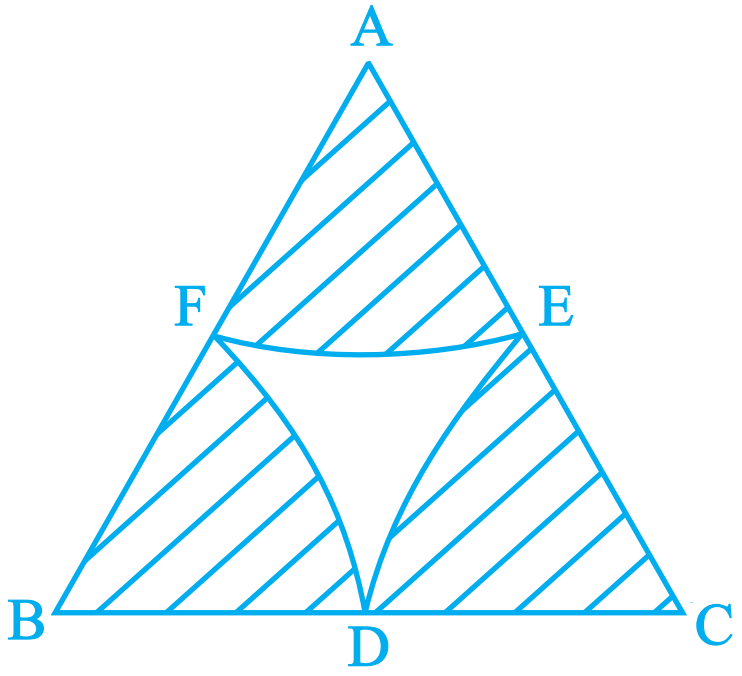
In Fig. arcs are drawn by taking vertices $A, B$ and $C$ of an equilateral triangle of side $10\ cm$. to intersect the sides $BC, CA$ and $AB$ at their respective mid$-$points $D, E$ and $F.$ Find the area of the shaded region $(\text{Use }\pi=3.14).$
Show graphically that each of the following given systems of equations is inconsistent, i.e., has no solutions:
2x + y = 6, 6x + 3y = 20
Solve the following quadratic equation:
$\Big(\frac{\text{4x}-3}{\text{2x}+1}\Big)-10\Big(\frac{\text{2x}+1}{\text{4x}-3}\Big)=3,$ $\text{x}\neq\frac{-1}{2},\ \frac{3}{4}$
Solve each of the following given systems of equations graphically and find the vertices and area of the triangle formed by these lines and the y-axis:
5x - y - 7 = 0, x - y + 1 = 0
Solve graphically the following system of linear equation. Also find the coordinates of the points where the lines meet axis of y.
$2x - y - 5 = 0,$
$x - y - 3 = 0.$
Prove the following identities:
$\big(1+\tan^2\theta\big)\big(1+\cot^2\theta\big)=\frac{1}{\big(\sin^2\theta-\sin^4\theta\big)}$
A solid right circular cone of height 120cm and radius 60cm is placed in a right circular cylinder full of water of height 180cm such that it touches the bottom. Find the volume of water left in the cylinder, if the radius of the cylinder is equal to the radius of the cone.
The perimeter of a rectangular plot is 62m and its area is 228 sq metres. Find the dimensions of the plot.