MCQ
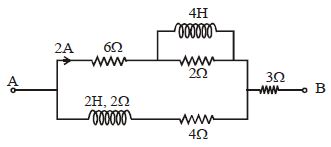
Find $V_A -V_B$ in steady state
  • A
    $8 $
  • B
    $16$
  • $24 $
  • D
    $28 $

Answer

Correct option: C.
$24 $
c
$\mathrm{R}_{\mathrm{AB}}=6$
$\mathrm{V}_{\mathrm{A}}-\mathrm{V}_{\mathrm{B}}=6 \times 2+3 \times 4=24 \mathrm{\,V}$

Need a full question paper?

Generate a complete, print-ready paper with questions like this in minutes — across 16+ boards, with answer keys.

Start Generating Free

Similar questions

The ratio of angular speeds of minute hand and hour hand of a watch is
The current sensitivity of moving coil galvanometer is increased by $25 \%$. This increase is achieved only by changing in the number of turns of coils and area of cross section of the wire while keeping the resistance of galvanometer coil constant. The percentage change in the voltage sensitivity will be $...........\%$
Net magnetic field at the centre of the circle $O$ due to a current carrying loop as shown in figure is $(\theta < 180^o)$
A cyclist is travelling with velocity $v$ on a curved road of radius $R$. The angle $\theta$  through which the cyclist leans inwards is given by
A circular coil of radius $10\; cm \;,\;500$ turns and resistance $2\; \Omega$ is placed with its plane, perpendicular to the horizontal component of the earth's magnetic field. It is rotated about its vertical diameter through $180^{\circ}$ in $0.25\; s$. The induced e.m.f in the coil is (Take $H E=\left.3.0 \times 10^{-5} \;T\right)$
Two masses of  $1\,kg$  and  $2\,kg$ respectively are connected by a massless spring as shown in figure. A force of  $20\,N$  acts on the  $2\,kg$  mass at the instant when the $1\, kg$  mass has an acceleration of  $10\,ms^{-2}$  towards right, the acceleration of the $2\,\,kg$  mass is ......... $ms^{-2}$
Certain radioactive substance reduces to $25\%$ of its value in $16\ days$. Its half-life is .......... $days$
Suppose the law of gravitational attraction suddenly changes and becomes an inverse cube law i.e. $F \propto {1\over r^3}$, but still remaining a central force. Then
The ratio of frequencies of two pendulums are $2 : 3$, then their length are in ratio
Column $I$ Contains a list of processes involving expansion of an ideal gas. Match this with Column $II$ describing the thermodynamic change during this process. Indicate your answer by darkening the appropriate bubbles of the $4 \times 4$ matrix given in the $ORS$.
Column $I$ Column $II$
$(A)$ An insulated container has two chambers separated by a valve. Chamber $I$ contains an ideal gas and the Chamber $II$ has vacuum. The valve is opened. $(p)$ The temperature of the gas decreases
$(B)$ An ideal monoatomic gas expands to twice its original volume such that its pressure $\mathrm{P} \propto \frac{1}{\mathrm{~V}^2}$, where $\mathrm{V}$ is the volume of the gas $(q)$ The temperature of the gas increases or remains constant
$(C)$ An ideal monoatomic gas expands to twice its original volume such that its pressure $\mathrm{P} \propto \frac{1}{\mathrm{~V}^{4 / 3}}$, where $\mathrm{V}$ is its volume $(r)$ The gas loses heat
$(D)$ An ideal monoatomic gas expands such that its pressure $\mathrm{P}$ and volume $\mathrm{V}$ follows the behaviour shown in the graph $Image$ $(s)$ The gas gains heat