MCQ
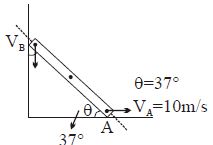
Find $V_B = ?$
  • A
    $V_A\,\,tan\,\,\theta $
  • B
    $V_A\,\,sec^2\,\,\theta $
  • C
    $V_A\,\,cosec\,\,\theta $
  • $V_A\,\,cot\,\,\theta $

Answer

Correct option: D.
$V_A\,\,cot\,\,\theta $
d

Need a full question paper?

Generate a complete, print-ready paper with questions like this in minutes — across 16+ boards, with answer keys.

Start Generating Free

Similar questions

A steel wire of diameter $2 \,mm$ has a breaking strength of $4 \times 10^5 \,N$.the breaking force ......... $\times 10^5 \,N$ of similar steel wire of diameter $1.5 \,mm$ ?
A perfectly elastic uniform string is suspended vertically with its upper end fixed to the ceiling and the lower end loaded with the weight. If a transverse wave is imparted to the lower end of the string, the pulse will
A block of mass $m$ rests on a platform. The platform is given up and down $SHM$ with an amplitude $d$ . What can be the maximum frequency so that the block never leaves the platform
When work is done on a body by an external force, its
Two rotating bodies $A$ and $B$ of masses $m$ and $2\,m$ with moments of inertia $I_A$ and $I_B (I_B> I_A)$ have equal kinetic energy of rotation. If $L_A$ and $L_B$ be their angular momenta respectively, then
If two waves of same frequency and same amplitude respectively, on superimposition produced a resultant disturbance of the same amplitude, the waves differ in phase by
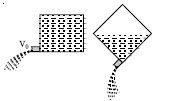
A cubical box of wine has a small spout located in one of the bottom corners. When the box is full and placed on a level surface, opening the spout results in a flow of wine with a initial speed of $v_0$ (see figure). When the box is half empty, someone tilts it at $45^o $ so that the spout is at the lowest point (see figure). When the spout is opened the wine will flow out with a speed of
As the temperature is increased, the time period of a pendulum:
  1. Increases as its effective length increases even though its centre of mass still remains at the centre of the bob.
  2. Decreases as its effective length increases even though its centre of mass still remains at the centre of the bob.
  3. Increases as its effective length increases due to shifting of centre of mass below the centre of the bob.
  4. Decreases as its effective length remains same but the centre of mass shifts above the centre of the bob.
What is the path followed by a moving body, on which a constant force acts in a direction other than initial velocity (i.e. excluding parallel and antiparallel direction)?
Molar specific heats for oxygen gas will be as per: