MCQ
Find wrong statement
  • A
    A car moving over a convex bridge is lighter than the same car resting on the same bridge
  • A car moving over a convex bridge is heavier than the same car resting on the same bridge
  • C
    A car moving over a concave bridge is heavier than the same car resting on the same bridge
  • D
    The weight of the car changes due to the centrifugal force for above cases
Answer

Correct option: B.
A car moving over a convex bridge is heavier than the same car resting on the same bridge
b
For convex bridge

$\mathrm{Mg}-\mathrm{N}=\frac{\mathrm{mv}^{2}}{\mathrm{R}}$

$\mathrm{N}=\mathrm{mg}-\frac{\mathrm{mv}^{2}}{\mathrm{R}}$

$\mathrm{N}<\mathrm{mg}$

For concave bridge

$\mathrm{N}-\mathrm{mg}=\frac{\mathrm{mv}^{2}}{\mathrm{R}}$

$\mathrm{N}=\mathrm{mg}+\frac{\mathrm{mv}^{2}}{\mathrm{R}}$

$N>m g$

Need a full question paper?

Generate a complete, print-ready paper with questions like this in minutes — across 16+ boards, with answer keys.

Start Generating Free

Similar questions

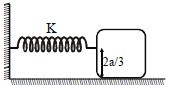
Find maximum amplitude for safe $SHM$ (block does not topple during $SHM$) of $a$ cubical block of side $'a'$ on a smooth horizontal floor as shown in figure (spring is massless)
A flask contains hydrogen and oxygen in the ratio of $2: 1$ by mass at temperature $27^{\circ} C$. The ratio of average kinetic energy per molecule of hydrogen and oxygen respectively is :
Beats are produced by two waves given by $y_1 = a\,\, sin\,\,2000\,\, \pi t$ and $y_2 = a\,\, sin\,\, 2008\,\, \pi t$ . The number of beats heard per second is
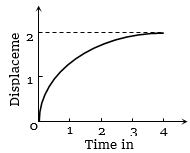
The displacement of a particle as a function of time is shown in the figure. The figure shows that
What happens to fringe width in Young’s double slit experiment if it is performed in glycerine instead of air
The maximum percentage errors in the measurement of mass (M), radius (R) and angular velocity $(\omega)$ of a ring are $2 \%, 1 \%$ and $1 \%$ respectively, then find the maximum percenta? error in the measurement of its rotational kinetic energy $\left(K=\frac{1}{2} I \omega^{2}\right)$
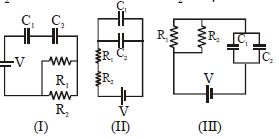
Given,

${R_1} = 1\,\Omega $                     $C_1 \,= 2\,\mu F$

${R_2} = 2\,\Omega $                     $C_2 \,= 4\,\mu F$

The time constants ( in $\mu\, s$) for the circuits $I, II, III$ are respectively

A magnet is dropped down an infinitely long vertical copper tube
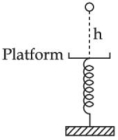
A ball of mass $100 \,g$ is dropped from a height $h =$ $10\, cm$ on a platform fixed at the top of vertical spring (as shown in figure). The ball stays on the platform and the platform is depressed by a distance $\frac{ h }{2}$. The spring constant is.......... $Nm^{-1}$ . (Use $g=10\, ms ^{-2}$ )
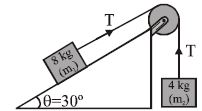
Two masses of $8\,kg$ and $4\,kg$ are connected by a string as shown in the figure over a fricitionless pulley. The acceleration of the system is  ............ $ m/sec^2$