Question
Find (x + y) + (x - y), if

$\text{x}=\frac{5}{4},\text{y}=\frac{-1}{3}$

Answer

$\text{x}=\frac{5}{4},\text{y}=\frac{-1}{3}$
$(\text{x}+\text{y})\div(\text{x}-\text{y})$
$=\Big(\frac{5}{4}+\frac{-1}{3}\Big)\div\Big(\frac{5}{4}-\frac{-1}{3}\Big)$
$=\Big(\frac{5\times3-1\times4}{12}\Big)\div\Big(\frac{12}{5\times3+1\times4}\Big)$
$=\Big(\frac{5\times3-1\times4}{{5\times3+1\times4}}\Big)$
$=\Big(\frac{11}{19}\Big)$

Need a full question paper?

Generate a complete, print-ready paper with questions like this in minutes — across 16+ boards, with answer keys.
Start Generating Free

Similar questions

$15$ men can build a $16.25m$ long wall up to a certain height in one day. How many men should be employed to build a wall of same height but of length $26$ metres in one day$?$
A man sold two radios for ₹ 5000 each. On one he gets a gain of 10% and on other a loss of 10%. Find his total gain or loss per cent in the whole transactions.
One day, during their vacation at a beach resort, Shella found twice as many sea shells as Anita and Anita found $5$ shells more than sandy. Together sandy and Shella found 16 sea shells. How many did each of them find?
Find the following product: $\frac{-4}{27}\text{xyz}\Big(\frac{9}{2}\text{x}^2\text{yz}-\frac{3}{4}\text{xyz}^2\Big)$
The base of an isosceles triangle is $48\ cm$ and one of its equal sides is $30\ cm$. Find the area of the triangle.
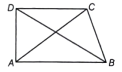
ABCD is a quadrilateral.
$
\text { Is } A B+B C+C D+D A>A C+B D \text { ? }
$
Image
Family photograph has length $14\frac{2}{5}\text{cm}$ and breadth $10\frac{2}{5}\text{cm}$ It has border of uniform width $2\frac{3}{5}\text{cm}$ Find the area of framed photograph.
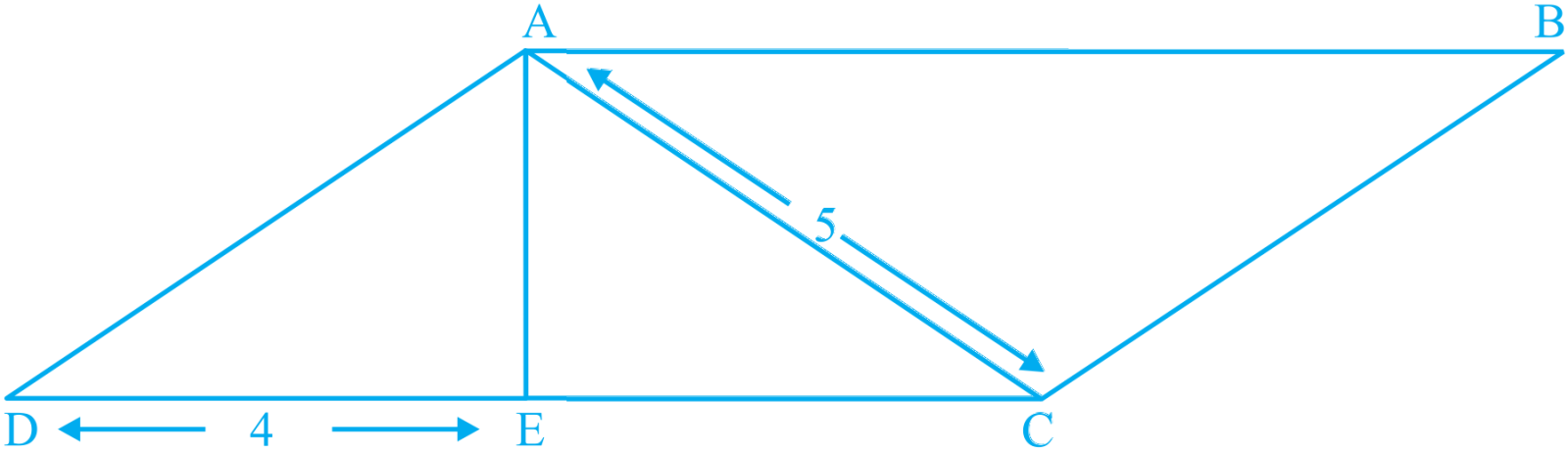
$ABCD$ is a parallelogram in which $AE$ is perpendicular to $CD$ Fig. Also $AC = 5\ cm, DE = 4\ cm,$ and the area of $\triangle\text{AED} = 6 \text{cm}^2.$ Find the perimeter and area of $ABCD.$
Simplify and express each of the following in exponential form.
$\left(2^3 \times 2\right)^2$
Dice are cubes with dots on each face. Opposite faces of a die always have a total of seven dots on them.  Here are two nets to make dice $($cubes$);$ the numbers inserted in each square indicate the number of dots in that box.
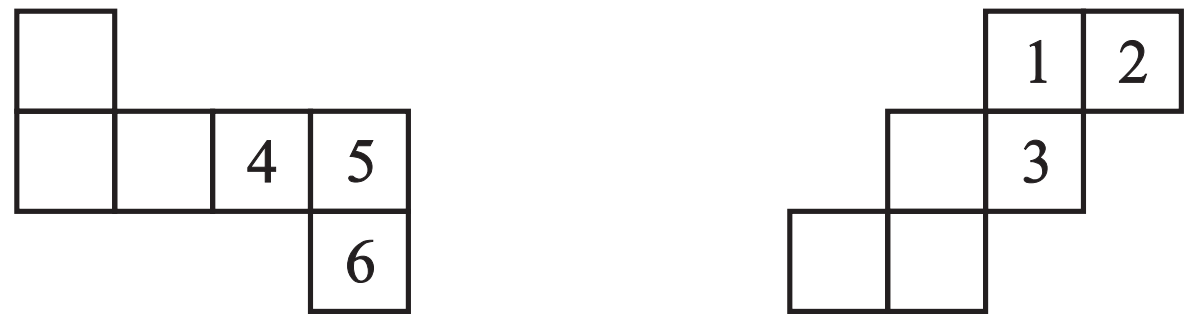
Insert suitable numbers in the blanks, remembering that the number on the opposite faces should total to $7.$