MCQ
First law of thermnodynamics is given by
  • $dQ = dU + PdV$
  • B
    $dQ = dU \times PdV$
  • C
    $dQ = (dU + dV)\,P$
  • D
    $dQ = PdU + dV$

Answer

Correct option: A.
$dQ = dU + PdV$
a
(a)$\Delta Q = \Delta U + \Delta W$ and $\Delta W = P\Delta V$

Need a full question paper?

Generate a complete, print-ready paper with questions like this in minutes — across 16+ boards, with answer keys.
Start Generating Free

Similar questions

The distance travelled by a particle starting from rest and moving with an acceleration $\frac{4}{3}$ $ms^{-2}$ in the third second is
The angular velocity of seconds hand of a watch will be 
An $HCl$ molecule has rotational, translational and vibrational motions. If the $rms$ velocity of $HCl$ molecules in its gaseous phase is $\bar v ,\,m$ is its mass and $k_B$ is Boltzmann constant, then its temperature will be
An artificial satellite moving in a circular orbit around the earth has a total (kinetic + potential) energy ${E_0}$. Its potential energy is
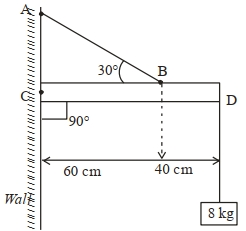
An object of mass $8\,kg$ is hanging from one end of a uniform rod $CD$ of mass $2\,kg$ and length $1\,m$ pivoted at its end $C$ on a vertical wall as shown in figure. It is supported by a cable $A B$ such that the system is in equilibrium. The tension in the cable is $............\,N$ (Take $g=10\,m / s ^2$ )
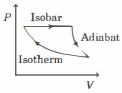
The efficiency of the cycle shown below in the figure (consisting of one isobar, one adiabat and one isotherm) is $50 \%$. The ratio $x$, between the highest and lowest temperatures attained in this cycle obeys (the working substance is an ideal gas)
Reason of weightlessness in a satellite is
A flat plate is moving normal to its plane through a gas under the action of constant force $F$. The gas is kept at a very low pressure. The speed of the plate $v$ is much less than the average speed $u$ of the gas molecules. Which of the following options is/are true?

[$A$] The resistive force experienced by the plate is proportional to $\mathrm{v}$

[$B$] The pressure difference between the leading and trailing faces of the plate is proportional to uv

[$C$] The plate will continue to move with constant non-zero acceleration, at all times

[$D$] At a later time the external force $F$ balances the resistive force.

Two particles A and B have a phase difference of $\pi$ when a sine wave passes through the region.
  1. A oscillates at half the frequency of B.
  2. A and B move in opposite directions.
  3. A and B must be separated by half of the wavelength.
  4. The displacements at A and B have equal magnitudes.
A simple harmonic oscillator has a period of $0.01 \,sec$ and an amplitude of $0.2\, m$. The magnitude of the velocity in $m{\sec ^{ - 1}}$ at the centre of oscillation is