Question
First three ionisation energies (in $kJ/mol$) of three representative elements are  given below

Element $IE_1$ $IE_2$ $IE_3$
$P$ $495.8$ $4562$ $6910$
$Q$ $737.7$ $1451$ $7733$
$R$ $577.5$ $1817$ $2745$

Then incorrect option is

Answer

c
$(c) \,R$ is $p-block$ element, because difference between $IE_2$ and $IE_3$ is  not very high as compared to between $IE_1$ and $IE_2$; hence stable  oxidation state of $R$ will be higher than $+2.$ 

Need a full question paper?

Generate a complete, print-ready paper with questions like this in minutes — across 16+ boards, with answer keys.

Start Generating Free

Similar questions

The substance that forms the plant cell walls is or Which carbohydrates is an essential constituents of plant cells
Which of the following order is correct regarding boiling point ?
On going from right to left in a period in the periodic table the electronegativity of the elements
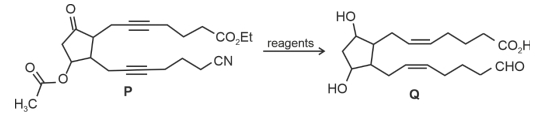
The option($s$) with correct sequence of reagents for the conversion of $P$ to $Q$ is(are)

$(A) i)$ Lindlar's catalyst, $H _2$; $ii$) $SnCl _2 / HCl$; iii) $NaBH _4$; iv) $H _3 O ^{+}$

$(B) i)$ Lindlar's catalyst, $H _2$; $ii$) $H _3 O ^{+}; iii)$ $SnCl _2 / HCl$; iv) $NaBH _4$

$(C) i)$ $NaBH _4; ii)$ $SnCl _2 / HCl; $iii$)$ $H _3 O ^{+}; iv)$ Lindlar's catalyst, $H _2$

$(D) i)$ Lindlar's catalyst, $H _2$; $ii$) $NaBH _4; iii)$ $SnCl _2 / HCl; iv)$ $H _3 O ^{+}$

The rate constant for the reaction $2N_2O_5 \to  4NO_2 + O_2$ is $3.0\times10^{-5}\, sec^{-1}$. If rate is $2.40\times10^{-5}\, M\, sec^{-1}$, then the concentration of $N_2O_5$ (in $M$) is ?
A solution of urea (mol. mass $56\,g\,mol^{-1}$ ) boils at $100.18\,^oC$ at the atmospheric pressure. If $K_f$ and $K_b$ for water are $1.86$ and $0.512\,K\,kg\,mol^{-1}$ respectively, the above solution will freeze at ........... $^oC$.
In a reaction

$C{H_2} = C{H_2}\xrightarrow[{oxid}]{{Hypochloro}}$ $M\xrightarrow{R}\begin{array}{*{20}{c}}
  {C{H_2} - OH} \\ 
  {|\,\,\,\,\,\,\,\,\,\,\,\,\,\,\,\,\,\,\,\,} \\ 
  {C{H_2} - OH} 
\end{array}$

Where $M$ = molecule; $R$ = reagent $M$ and $R$ are

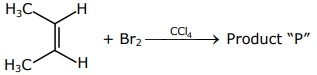
Consider the above chemical reaction. The total number of stereoisomers possible for product $'\mathrm{P}^{\prime}$ is $.....$
Match each coordination compound in List $-I$ with an appropriate pair of characteristics from List $-II$ and select the correct answer using the code given below the lists. $\{en$ $= H_2NCH_2CH_2NH_2$, atomic numbers : $Ti = 22; Cr = 24; Co = 27; Pt = 78$ $ \}$
  List$-I$   List$-II$
$(P)$ $[Cr(NH_3)_4Cl_2]Cl$ $(1)$ Paramagnetic and exhibits ionisation isomerism
$(Q)$ $[Ti(H_2O)_5Cl](NO_3)_2$ $(2)$ Diamagnetic and exhibits cis-trans isomerism
$(R)$ $[Pt(en)(NH_3)Cl]NO_3$ $(3)$ Paramagnetic and exhibits cis-trans isomerism
$(S)$ $[Co(NH_3)_4(NO_3)_2]NO_3$ $(4)$ Diamagnetic and exhibits ionisation isomerism
A reaction of cobalt $(III)$ chloride and ethylenediamine in a $1 : 2$ mole ratio generates two isomeric products $A$ (violet coloured) and $B$ (green coloured). $A$ can show optical activity, but, $B$ is optically inactive. What type of isomers does $A$ and $B$ represent?