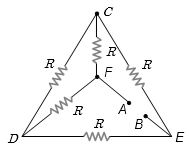
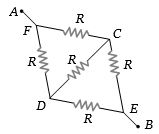
Five equal resistances each of resistance $R$ are connected as shown in the figure. A battery of $V\, volts$ is connected between $A$ and $B$. The current flowing in $AFCEB$ will be
AIPMT 2004, Medium


Download our appand get started for free
Experience the future of education. Simply download our apps or reach out to us for more information. Let's shape the future of learning together!No signup needed.*
Similar Questions
- 1What length of the wire of specific resistance $48 \times {10^{ - 8}}\,\Omega \,\,m$ is needed to make a resistance of $4.2 \, \Omega$ .............. $m$ (diameter of wire = $0.4\, mm$)View Solution
- 2A car battery of $e.m.f$. $12\,V$ and internal resistance $5 \times {10^{ - 2}}\,\Omega $, receives a current of $60\; A$ from external source, then terminal voltage of battery isView Solution
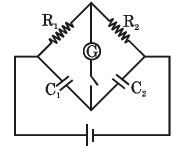
- 3View SolutionCircuit shown is in steady state, now when switch is closed, galvanometer shows no deflection, then correct relation is
- 4Three resistances $4\,\Omega $ each of are connected in the form of an equilateral triangle. The effective resistance between two corners isView Solution
- 5The balancing length for a cell is $560 \;\mathrm{cm}$ in a potentiometer experiment. When an external resistance of $10 \;\Omega$ is connected in parallel to the cell, the balancing length changes by $60\; \mathrm{cm} .$ If the internal resistance of the cell is $\frac{\mathrm{N}}{10} \;\Omega,$ where $\mathrm{N}$ is an integer then value of $\mathrm{N}$ isView Solution
- 6A student is provided with a variable voltage source $V$, a test resistor $R_T=10\,\Omega$, two identical galvanometers $G_1$ and $G_2$ and two additional resistors, $R _1=10\,M\,\Omega$ and $R _2=0.001\,\Omega$. For conducting an experiment to verify ohms law, the most suitable circuit is:View Solution
- 7$STATEMENT-1$ In a Meter Bridge experiment, null point for an unknown resistance is measured. Now, the unknown resistance is put inside an enclosure maintained at a higher temperature. The null point can be obtained at the same point as before by decreasing the value of the standard resistance. andView Solution
$STATEMENT-2$ Resistance of a metal increases with increase in temperature.
- 8$12$ cells each having same $emf$ are connected in series with some cells wrongly connected. The arrangement is connected in series with an ammeter and two cells which are in series. Current is $3 \,A$ when cells and battery aid each other and is $2\, A$ when cells and battery oppose each other. The number of cells wrongly connected isView Solution
- 9Two wires each of radius of cross section $r$ but of different materials are connected together end to end (in series). If the densities of charge carriers in the two wires are in the ratio $1 : 4$, the drift velocity of electrons in the two wires will be in the ratio:View Solution
- 10Coefficient of linear expansion of material of resistor is $\alpha$. Its temperature coefficient of resistivity and resistance are $\alpha_\rho$ and $\alpha_R$ respectively, then correct relation isView Solution