MCQ
Fluorine does not show variable oxidation states because $......?$
  • A
    It is a halogen.
  • Of absence of $d-$orbitals.
  • C
    Absence of $s-$orbital.
  • D
    Absence of $p-$orbitals.

Answer

Correct option: B.
Of absence of $d-$orbitals.
Fluorine cannot expand its octet due to absence of $d-$orbitals.
Therefore it cannot show variable oxidation states.

Need a full question paper?

Generate a complete, print-ready paper with questions like this in minutes — across 16+ boards, with answer keys.

Start Generating Free

Similar questions

Concentrated $HNO_3$ reacts with iodine to give
On electrolysis of dil. sulphuric acid using Platinum $(Pt)$ electrode, the product obtained at anode will be:
Consider the following sequence of reactions

${{C}_{6}}{{H}_{6}}+C{{H}_{3}}CH=C{{H}_{2}}\xrightarrow[heat]{{{H}_{3}}P{{O}_{4}}}A\xrightarrow[2.\,{{H}_{3}}{{O}^{+}},heat]{1.\,{{O}_{2}},heat}B+C$

The products $(B)$ and $(C)$ are

$\text{TEL},$ tetraethyl lead, acts as an anti$-$knocking agent. It acts as:
The rate of certain reaction depends on concentration according to the equation $\frac{{ - dc}}{{dt}} = \frac{{{K_1}C}}{{1 + {K_2}C}},$ what is the order, when concentration $(c)$ is very-very high
Consider the kinetic data given in the following table for the reaction $A + B + C \rightarrow$ Product.

Experiment No. $\begin{array}{c}{[ A ]} \\ \left( mol dm ^{-3}\right)\end{array}$ $\begin{array}{c}{[ B ]} \\ \left( mol dm ^{-3}\right)\end{array}$ $\begin{array}{c}{[ C]} \\ \left( mol dm ^{-3}\right)\end{array}$ Rate of reaction $\left( mol dm ^{-3} s ^{-1}\right)$
$1$ $0.2$ $0.1$ $0.1$ $6.0 \times 10^{-5}$
$2$ $0.2$ $0.2$ $0.1$ $6.0 \times 10^{-5}$
$3$ $0.2$ $0.1$ $0.2$ $1.2 \times 10^{-4}$
$4$ $0.3$ $0.1$ $0.1$ $9.0 \times 10^{-5}$

The rate of the reaction for $[ A ]=0.15 mol dm ^{-3},[ B ]=0.25 mol dm ^{-3}$ and $[ C ]=0.15 mol dm ^{-3}$ is found to be $Y \times 10^{-5} mol dm d ^{-3} s ^{-1}$. The value of $Y$ i. . . . . . .
A triglyceride can have how many different acyl groups?
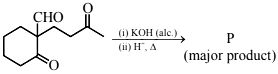
The major product $(P)$ in the following reaction is :
Shapes of certain interhalogen compounds are stated below. Which one of them is not correctly stated?
Total number of unpaired electrons in the complex ion $\left[\mathrm{Co}\left(\mathrm{NH}_3\right)_6\right]^{3+}$ and $\left[\mathrm{NiCl}_4\right]^{2-}$ is...............