- A$B{F_3}$ is not spherically symmetrical but $P{F_3}$ is
- B$B{F_3}$ molecule must be linear
- CThe atomic radius of $P$ is larger than the atomic radius of $B$
- ✓The $B{F_3}$ molecule must be planar triangular
$BF _3$ is planar triangular while $PF _3$ is pyramidal.
Generate a complete, print-ready paper with questions like this in minutes — across 16+ boards, with answer keys.
$6CO_2 + 6H_2O + solar energy \to C_6H_{12}O_6+6O_2$
A blue whales gain $75\ kg$ of mass per day by feeding on krill. The whale must consume ten times this mass of krill each day. The krill must consume $10.0\ kg$ of diatoms to produce $1.0\ kg$ of krill. Assuming that the mass gain of a whale's life is due to the consumption of carbohydrates $(C_6H_{12}O_6)$ , calculate the moles of $CO_2$ that must be used by the diatoms to produce the carbohydrates consumed by a blue whale in a day
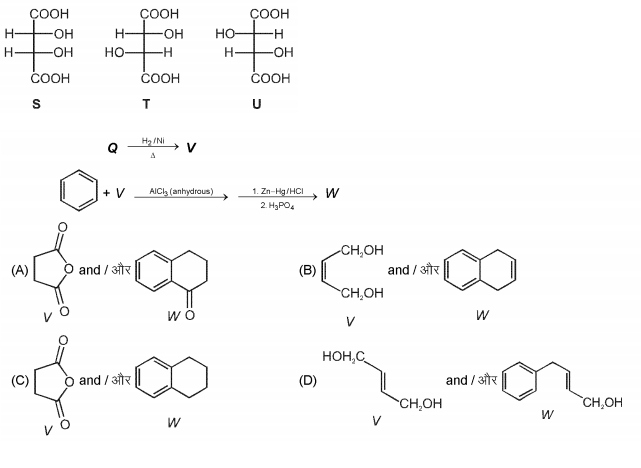
Upon treatment with dilute alkaline $KMnO _4, P$ as well as $Q$ could produce one or more than one from $S , T$ and $U$.$Image$
$1.$ Compounds formed form $P$ and $Q$ are, respectively
$(A)$ Optically active $S$ and optically active pair $(T, U)$
$(B)$ Optically inactive $S$ and optically inactive pair $(T, U)$
$(C)$ Optically active pair $(T, U)$ and optically active $S$
$(D)$ Optically inactive pair $(T, U)$ and optically inactive $S$
$2.$ In the following reaction sequences $V$ and $W$ are respectively :$Image$
mcq $Image$
Give the answer question $1$ and $2.$