MCQ
Fluorobenzene $(C_6H_5F)$ can be synthesized in the laboratory
  • A
    by direct fluorination of benzene with $F_2$ gas
  • B
    by reacting bromobenzene with $NaF$ solution
  • C
    by heating phenol with $HF$ and $KF$
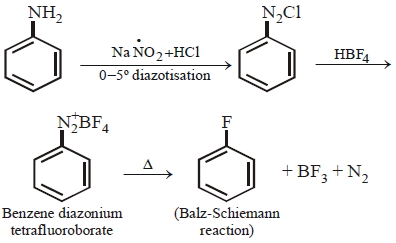
  • from aniline by diazotisation followed by heating the diazonium salt with $HBF_4$
Answer

Correct option: D.
from aniline by diazotisation followed by heating the diazonium salt with $HBF_4$
d

Need a full question paper?

Generate a complete, print-ready paper with questions like this in minutes — across 16+ boards, with answer keys.

Start Generating Free

Similar questions

Assertion : The boiling points of aldehydes and ketones are higher than hydrocarbons and ethers of comparable molecular masses.
Reason : There is a weak molecular association in aldehydes and ketones arising out of the dipole-dipole interactions
A lone pair of electrons in an atom implies
The value of the energy for the first excited state of hydrogen atom will be ............. $\mathrm{eV}$
Benzaldehyde on heating with acetone in presence of $NaOH$ gives 
Consider the following statements pertaining to fuel cells :-
$(a)$ Hydrogen oxygen fuel cell make use of concentrated $KOH$ solution as  electrolyte and porous graphite impregnated with platinum as electrodes
$(b)$ The efficiency of fuel cell is less then unity due to polarisation at electrodes and  the resistance offered by the electrode and the electrolyte
$(c)$ The electrical work, assuming the cell to be working reversibly may be  represented as $-\Delta G = W_{electrical} = -\Delta H + T \Delta S$
Which of the above statements are correct
The molality of a $10 \%( v / v )$ solution of di-bromine solution in $CCl _4$ (carbon tetrachloride) is $x$. $x=$ $......\times 10^{-2}\,M$. (Nearest integer)

[Given : molar mass of $Br _2=160\,g\,mol ^{-1}$

atomic mass of $C =12\,g\,mol ^{-1}$

atomic mass of $Cl =35.5\,g\,mol ^{-1}$

density of dibromine $=3.2\,g\,cm ^{-3}$

density of $\left.CCl _4=1.6\,g\,cm ^{-3}\right]$

The major product ($Y$) in the following reactions is

$\begin{array}{*{20}{c}}
  {C{H_3}\,\,\,\,\,\,\,\,\,} \\ 
  {|\,\,\,\,\,\,\,\,\,\,\,\,\,\,} \\ 
  {C{H_3} - CH - C = CH} 
\end{array}\xrightarrow[{{H_2}O}]{{HgS{O_4},{H_2}S{O_4}}}X$ $\xrightarrow[{(ii)\,conc.{H_2}S{O_4}/\Delta }]{{(i)\,{C_2}{H_5}MgBr,{H_2}O}}Y$

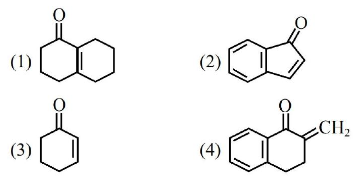
Aldol condensation is a popular and classical method to prepare $\alpha, \beta$-unsaturated carbonyl compounds. This reaction can be both intermolecular and intramolecular. Predict which one of the following is not a product of intramolecular aldol condensation?
Image
Acetylene molecule has carbon in
Identify the species $X$ in the reaction :${\rm{Propene }} + O\,{\rm{ (conc}}{\rm{. acidic\, }}KMn{O_4}) \to X + {\rm{Formic\, acid}}$