Question
Following are the features of genetic codes. What does each one indicate?
Stop codon, Unambigous codon, degenerate codon, universal codon.###What do you understand by genetic code? Describe the types and characteristics of genetic code in detail.###What is Genetic code and give detail about them?###Write about characteristics and properties of Genetic code.
Answer

Genetic Code : During replication and transcription a nucleic acid was copied to form another nucleic acid. Hence these processes are easy to conceptualize on the basis of complementarily. The process of translation required transfer of genetic information from a polymer of nucleotides to a polymer of amino acid.
Characteristics :
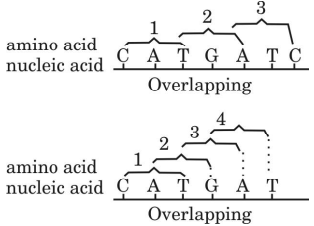
(a) Commaless : Genetic code is commaless. This means that the arrangement of triplet codons on m-RNA is one after other without a gap.
(b) Non-ambiguous nature : Each codon specifies a particular amino acid. The only exception is AUG which codes for methionine and GUG and codes for valine. But in the absence of AUG, GUG can also code methionine.
(c) Degenerate nature : There are 61 codons for 20 amino acids. But some amino acids are coded by more than one codon. Hence it is said to be degenerated. e.g. GGG, GGA, GGC and GGU all GGU all code for glycine.
Image
(d) Polarity : Genetic code could be read only in 5'-3' direction on m-RNA. This polarity is the important aspect of the genetic code. It also has start and stop signals. Start or initiation codon is AUG while UAG, UAA, UGA are the stop or termination codes.
(e) Universality : Genetic code is universal for all the organisms from simple bacteria to complex organisms.

Need a full question paper?

Generate a complete, print-ready paper with questions like this in minutes — across 16+ boards, with answer keys.

Start Generating Free

Similar questions

(a) Write the name of primates existing on earth about 15 million years ago. Write its important characteristics also?
(b) (i) From where did the animals similar to human being meet?
(ii) In which sequence were neanderthal, homohabilis and homo erectus evolved on earth?
(iii) When did modern man evolve on this planet?
Explain briefly the ‘rivet popper hypothesis’ of Paul Ehrlich.
Himani while watching a TV programme based on life in polar region observed that all animals in polar regions possess larger size. Also, smaller animals are not found in that region. She asked about this surprising fact to her teacher.
  1. Why smaller animals (e.g. humming birds) are rarely found in polar regions?
  2. What are the adaptations shown by polar animals?
  3. What are the chief characteristics of polar region animals?
  4. What values are shown by Himani?
Describe the structure of DNA.###Describe the DNA proposed by Watson and Crick.
State and explain any three factors affecting allele frequency in populations.
  1. How does a chromosomal disorder differ from a Mendelian disorder?
  2. Name any two chromosomal aberration associated disorders.
  3. List the characteristics of the disorders mentioned above that help in their diagnosis.
Enlist the salient features of the double helix structure of DNA.
A woman with blood group “A” marries a man with blood group “O”. Discuss the possibilities of the inheritance of the blood groups in the following starting with “yes” or “no” for each:
  1. They produce children with blood group “A” only.
  2. They produce children some with “O” blood group and some with “A” blood group.
What are the various advantages of using genetically modified plants to increase the overall yield of the crop?
Describe in sequence the events that lead to the development of a 3-celled pollen grain from microspore mother cell in angiosperms.