MCQ
Following sets of three forces act on a body. Whose resultant cannot be zero
  • A
    $10, 10, 10$
  • B
    $10, 10, 20$
  • C
    $10, 20, 23$
  • $10, 20, 40$

Answer

Correct option: D.
$10, 20, 40$
d
(d) From the triangle law of vector addition the resultant must be zero if sum of two forces $\geq$ remaining force. If you check for all option only option $D$ not valid for it because $10+20=30<40$

Need a full question paper?

Generate a complete, print-ready paper with questions like this in minutes — across 16+ boards, with answer keys.
Start Generating Free

Similar questions

The rate of steady volume flow of water through a capillary tube of length $ 'l' $ and radius $ 'r' $ under a pressure difference of $P$  is $V$. This tube is connected with another tube of the same length but half the radius in series. Then the rate of steady volume flow through them is (The pressure difference across the combination is $ P$)
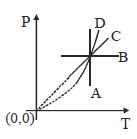
Following figure shows $P-T$ graph for four processes $A, B, C$ and $D$. Select the correct alternative
Four equal positive charges are fixed at the vertices of a square of side $L$. $Z$-axis is perpendicular to the plane of the square. The point $z = 0$ is the point where the diagonals of the square intersect each other. The plot of electric field due to the four charges, as one moves on the $z-$ axis.
Maxwell’s equations describe the fundamental laws of
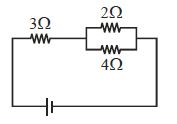
If power in $3\,\Omega $ is $27\,W$ then what is the power in $2\,\Omega $  ................ $\mathrm{W}$
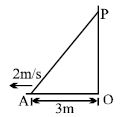
A ladder $AP$ of length $5\,\, m$ is inclined to a vertical wall is slipping over a horizontal surface with velocity of $2\,\, m/s,$ when $A$ is at a distance $3\ m$ from ground what is the velocity of $C.M.$ at this moment   .......... $m/s$
A small particle of mass $m$ moves in such a way that its potential energy $U=\frac{1}{2} m \omega^2 r ^2$ where $\omega$ is constant and $r$ is the distance of the particle from origin. Assuming Bohr's quantization of momentum and circular orbit, the radius of $n^{\text {th }}$ orbit will be proportional to.
The ratio of the adiabatic to isothermal elasticities of a triatomic gas is
The maximum vertical height to which a man can throw a ball is $136\,m$. The maximum horizontal distance upto which he can throw the same ball is $.....\,m$
Two radioactive substances $X$ and $Y$ originally have $N _{1}$ and $N _{2}$ nuclei respectively. Half life of $X$ is half of the half life of $Y$. After three half lives of $Y$, number of nuclei of both are equal. The ratio $\frac{ N _{1}}{ N _{2}}$ will be equal to