MCQ
Following sets of three forces act on a body. Whose resultant cannot be zero
  • A
    $10, 10, 10$
  • B
    $10, 10, 20$
  • C
    $10, 20, 23$
  • $10, 20, 40$

Answer

Correct option: D.
$10, 20, 40$
d
(d) From the triangle law of vector addition the resultant must be zero if sum of two forces $\geq$ remaining force. If you check for all option only option $D$ not valid for it because $10+20=30<40$

Need a full question paper?

Generate a complete, print-ready paper with questions like this in minutes — across 16+ boards, with answer keys.
Start Generating Free

Similar questions

Which of the fact is not due to surface tension
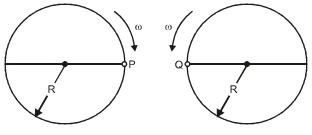
Two identical discs of same radius $R$ are rotating about their axes in opposite directions with the same constant angular speed $\omega$. The disc are in the same horizontal plane.At time $t=0$, the points $P$ and $Q$ are facing each other as shown in the figure. The relative speed between the two points $P$ and $Q$ is $v_r$ as function of times best represented by
The figure shows a process on a gas in which pressure and volume both change. The molar heat capacity for this process is C.
  1. C = 0
  2. C = Cv
  3. C > Cv
  4. C < Cv
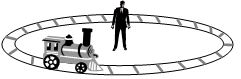
An engine is moving on a circular track with a constant speed. It is blowing a whistle of frequency $500 Hz$. The frequency received by an observer standing stationary at the centre of the track is
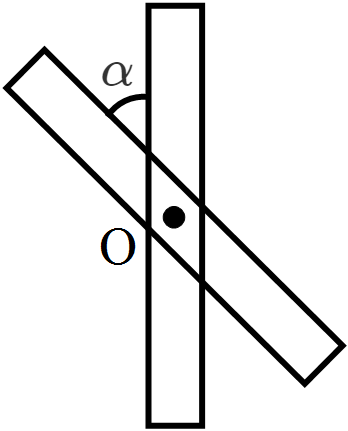
Two identical rods of mass M and length I are lying in a horizontal plane at an angle a. The MI of the system of two rods about an axis passing through O and perpendicular to the plane of the rods is:

An object of $1 \,kg$ mass has a momentum of $10 \,kg$ $m/sec $ then the kinetic energy of the object will be .............. $\mathrm{J}$
$A$ cylinder is pure rolling up an incline plane. It stops momentarily and then rolls back. The force of friction
Two moles of an ideal monoatomic gas at ${27^o}C$ occupies a volume of $V.$ If the gas is expanded adiabatically to the volume $2V,$ then the work done by the gas will be ....... $J$ $[\gamma = 5/3,\,R = 8.31J/mol\,K]$
A polyatomic ideal gas has $24$ vibrational modes. What is the value of $\gamma$ ?
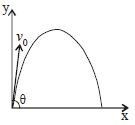
A small particle of mass $m$ is projected at an angle $\theta $ with the $x-$ axis with an initial velocity $v_0$ in the $x-y$ plane as shown in the figure. At a time $t < \frac{{{v_0}\,\sin \,\theta }}{g}$, the angular momentum of the particle is