MCQ
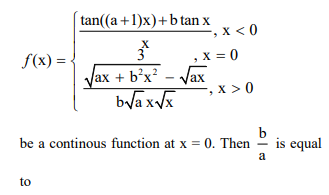
For $a, b > 0,$ let
Image
  • A
    5
  • B
    4
  • C
    8
  • D
    6

Answer

$\lim _{x \rightarrow 0} f(x)=f(0)=3$
$\lim _{x \rightarrow 0^{+}} \frac{\sqrt{a x+b^2 x^2}-\sqrt{a x}}{b \sqrt{a} x \sqrt{x}}=3$
$\lim _{x \rightarrow 0^{+}} \frac{a x+b^2 x^2-a x}{b \sqrt{a} x^{3 / 2}\left(\sqrt{a x+b^2 x^2}+\sqrt{a x}\right)}$
$\lim _{x \rightarrow 0^{+}} \frac{b^2}{b \sqrt{a}\left(\sqrt{a+b^2 x}+\sqrt{a}\right)}$
$\frac{b}{\sqrt{a} \cdot 2 \sqrt{a}} $
$\Rightarrow \frac{b}{2 a}=3 $
$\Rightarrow \frac{b}{a}=6$

Need a full question paper?

Generate a complete, print-ready paper with questions like this in minutes — across 16+ boards, with answer keys.
Start Generating Free

Similar questions

If $z$ be a complex number satisfying $|\operatorname{Re}(z)|+|\operatorname{Im}(z)|=4,$ then $|z|$ cannot be
The probability of getting a number greater than $2$ in throwing a die is
If the equation $2\ {\sin ^2}x + \frac{{\sin 2x}}{2} = k$ , has atleast one real solution, then the sum of all integral values of $k$ is
Let the focal chord PQ of the parabola $y^2=4 x$ make an angle of $60^{\circ}$ with the positive x -axis, where P lies in the first quadrant. If the circle, whose one diameter is PS, S being the focus of the parabola, touches the $y$-axis at the point $(0, \alpha)$, then $5 \alpha^2$ is equal to :
Let $f:[1, \infty) \rightarrow[2, \infty)$ be a differentiable function, If $10 \int_{1}^{x} f(\mathrm{t}) \mathrm{dt}=5 \mathrm{x} f(\mathrm{x})-\mathrm{x}^{5}-9$ for all $\mathrm{x} \geq 1$, then the value of $f(3)$ is :
If the Coefficient of $x^{30}$ in the expansion of $\left(1+\frac{1}{x}\right)^6\left(1+x^2\right)^7\left(1-x^3\right)^8 ; x \neq 0$ is $\alpha$, then $|\alpha|$ equals
The function ${x^5} - 5{x^4} + 5{x^3} - 1$  is
Let $\mathrm{f}: N \rightarrow N$ be a function such that $\mathrm{f}(\mathrm{m}+\mathrm{n})=\mathrm{f}(\mathrm{m})+\mathrm{f}(\mathrm{n})$ for every $\mathrm{m}, \mathrm{n} \in N$. If $\mathrm{f}(6)=18$ then $\mathrm{f}(2) \cdot \mathrm{f}(3)$ is equal to :
The sum of first $n$ terms of the given series ${1^2} + {2.2^2} + {3^2} + {2.4^2} + {5^2} + {2.6^2} + ............$ is $\frac{{n{{(n + 1)}^2}}}{2}$, when $n$ is even. When $n$ is odd, the sum will be
How many points having integer co-ordinates are there in the feasible region of the inequality $3 x+4 y \leq 12, x \geq 0$ and $y \geq 1$ ?