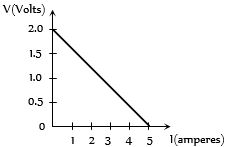
For a cell, the graph between the potential difference $(V) $ across the terminals of the cell and the current $(I)$ drawn from the cell is shown in the figure. The $e.m.f.$ and the internal resistance of the cell are
A$2\,V$, $0.5\,\Omega $
B$2\,V$, $0.4\,\Omega $
C$ > 2\,V$, $0.5\,\Omega $
D$ > 2\,V$, $0.4\,\Omega $
Medium
Download our app for free and get started
B$2\,V$, $0.4\,\Omega $
b E.m.f. is the value of voltage, when no current is drawn from the circuit so $E = 2\,V$.
Also $r = $ slope $=\frac{2}{5} = 0.4\,\Omega $
Download our app
and get started for free
Experience the future of education. Simply download our apps or reach out to us for more information. Let's shape the future of learning together!No signup needed.*
Figure shows a thick shell made of electrical conductivity $\sigma$ and has inner & outer radii of $10\ cm$ & $20\ cm$ respectively and is filled with ice inside it. Its inside and outside surface are kept at different potentials by a battery of internal resistance $\frac{2}{\pi} \Omega \ \&\ \epsilon = 5V$. Find value of $\sigma$ for which ice melts at maximum possible rate if $25\%$ of heat generated by shell due to joule heating is used to melt ice.
When a current of $2\,A$ flows in a battery from negative to positive terminal, the potential difference across it is $12\,V$. If a current of $3\,A$ flows in the opposite direction potential difference across the terminals of the battery is $15\,V$, the emf of the battery is ............... $\mathrm{V}$
The number density of free electrons in copper is nearly $8 \times 10^{28}\,m ^{-3} . A$ copper wire has its area of cross section $=2 \times 10^{-6}\,m ^2$ and is carrying a current of $3.2\,A$. The drift speed of the electrons is $.....\times 10^{-6}\,ms ^{-1}$.
In the circuit shown below, a student performing Ohm's law experiment accidently puts the voltmeter and the ammeter as shown in the circuit below. The reading in the voltmeter will be close to .......... $V$