Question
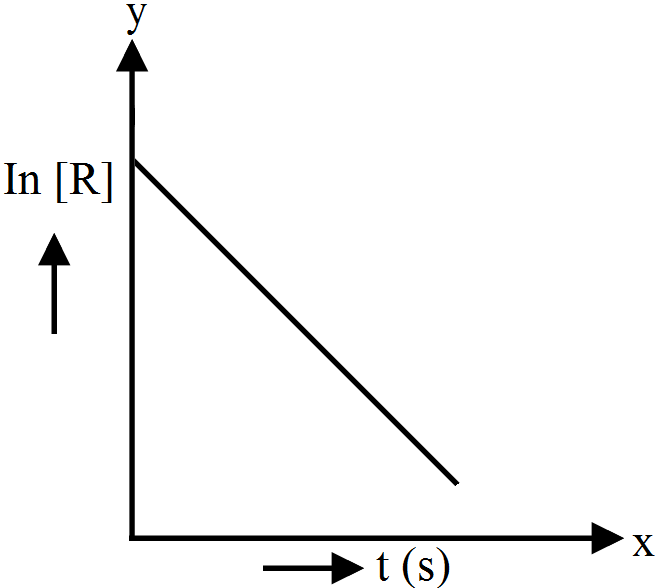
For a certain chemical reaction variation in the concentration ln [R] vs. time plot is given alongside.

For this reaction:

  1. What is the order of the reaction?
  2. What are the units of rate constant k?
  3. Give the relationship between k and t1/2 (half-life period).
  4. What is the slope of the curve?
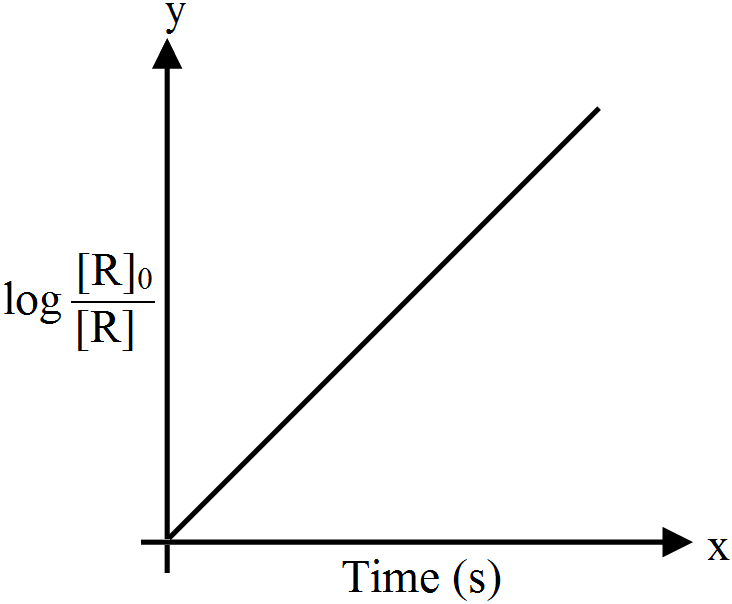
  5. Draw the plot log [R]0 /[R] vs time t(s).
Answer

  1. First order.
  2. Time-1 (s-1)
  3. $\text{k}=\frac{0.693}{\text{t}_{1/2}}$
  4. Slope = - k (rate constant).
  5.  

Need a full question paper?

Generate a complete, print-ready paper with questions like this in minutes — across 16+ boards, with answer keys.

Start Generating Free

Similar questions

  1. Answer the following questions briefly:
  1. What are any two good sources of vitamin A?
  2. What are nucleotides?
  3. Give an example of simple lipids.
  1. How are carbohydrates classified?
Write the IUPAC names of the following coordination compounds:
i. $\left[ Co \left( NH _3\right) 6\right] Cl _3$
ii. $\left[ Co \left( NH _3\right)_5 Cl \right] Cl _2$
iii. $K_3\left[ Fe ( CN )_6\right]$
iv. $K_3\left[ Fe \left( C _2 O _4\right)_3\right]$
v. $K_2\left[P_{d C l}^4\right]$
vi. $\left[ Pt \left( NH _3\right)_2 Cl \left( NH _2 CH _3\right)\right] Cl$
  1. What is meant by:
  1. Colligative properties.
  2. Molality of a solution.
  1. What concentration of nitrogen should be present in a glass of water at room temperature? Assume a temperature of 25°C, a total pressure of 1 atmosphere and mole fraction of nitrogen in air of 0.78. [KH for nitrogen = 8.42 x 10⁻⁷ M/mm Hg].
  1. Define the following terms:
  1. Mole fraction.
  2. Ideal solution.
  1. 15.0 g of an unknown molecular material is dissolved in 450 g of water. The resulting solution freezes at - 0.34°C. What is the molar mass of the material?

(Kf for water = 1.86 K kg mol–1).

Using IUPAC norms write the formulas for the following:
a. Tetrahydroxozincate(II)
b. Potassium tetrachloridopalladate(II)
c. Diamminedichloridoplatinum(II)
d. Potassium tetracyanonickelate(II)
e. Pentaamminenitrito-O-cobalt(III)
f. Hexaamminecobalt (III) sulphate
g. Potassium tri(oxalato) chromate(III)
h. Hexaammineplatinum(IV)
i. Tetrabromidocuprate(II)
j. Pentaamminenitrito-N-cobalt(III)
Explain the energy distribution curve of gaseous molecules and also discuss the effect of temperature on it.
Attempt any five of the following:
(a) Which sugar is present in milk?
(b) Why must vitamin C be supplied regularly in diet?
(c) What type of substance is phenylanine hydroxylate? Write its importance.
(d) Define denaturation of protein. What is the effect of denaturation on the structure of protein?
(e) Name the linkage connecting monosaccharide units in polysaccharides.
(f) How do you explain the presence of all six carbon atoms in glucose in a straight chain?
(g) Write the reactions showing the presence of following in the open structure of glucose:
i. a carbonyl group
ii. chain with six carbon atoms
What is crystal field splitting energy? How does the magnitude of $\Delta_0$ decide the actual configuration of d-orbitals in a coordination entity?
Match the solutions given in Column I and the colours given in Column II.
 
Column I
(Aqueous solution of salt)
 
Column II
(Colour)
(i)
FeSO4.7H2O
(a)
Green
(ii)
NiCl2.4H2O
(b)
Light pink
(iii)
MnCl2.4H2O
(c)
Blue
(iv)
CoCl2.6H2O
(d)
Pale green
(v)
Cu2Cl2
(e)
Pink
 
 
(f)
Colourless
Answer the following questions:
Assign reasons for the following:
  1. In the series Sc (Z = 21) to Zn (Z = 30), the enthalpy of atomisation of Zn is the lowest.
  2. Zr and Hf have almost identical radii.
  3. Transition metals show variable oxidation states.
  4. The E°M2+/M value for copper is positive (+0.34 V).