MCQ
For a chemical reaction....can never be a fraction
  • A
    Order
  • B
    Half-life
  • Molecularity
  • D
    Rate constant

Answer

Correct option: C.
Molecularity
c
Molecularity of a reaction can never be zero as the no. of particles colliding each other can not be a fraction.

Need a full question paper?

Generate a complete, print-ready paper with questions like this in minutes — across 16+ boards, with answer keys.

Start Generating Free

Similar questions

Codon is present in
Which of the following statements regarding chemical properties of acetophenone are wrong

$(1)$ It is reduced to methyl phenyl carbinol by sodium and ethanol

$(2)$ It is oxidised to benzoic acid with acidified $KMn{O_4}$

$(3)$ It does not undergo iodoform electrophilic substitution like nitration at meta position

$(4)$ It does not undergo iodoform reaction with iodine and alkali
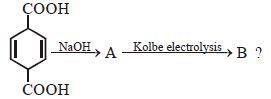
Which reaction will give $\begin{array}{*{20}{c}}
  {C{H_3} - CH - CH - C{H_2}} \\ 
  {\,\,\,\,\,\,\,\,\,\,\,\,|\,\,\,\,\,\,\,\,\,\,\,\,\,\,\,\,|\,\,\,\,\,\,\,\,\,\,\,\,\,\,\,\,|\,\,} \\ 
  {\,\,\,\,\,\,\,\,\,\,\,\,C{H_3}\,\,\,\,\,\,\,\,OH\,\,\,\,\,\,\,H\,\,} 
\end{array}$ as a major product
$\,$
Among the following substances the lowest vapour pressure is exerted by
Which of the following statements is not true about sucrose?
Which of the following is formed by the action of water on sodium peroxide
Arrange the following Cobalt complexes in the order of increasing Crystal Field Stabilization Energy $(CFSE)$ value.

Complexes : $\left[\mathrm{CoF}_{6}\right]^{3-},\left[\mathrm{Co}\left(\mathrm{H}_{2} \mathrm{O}\right)_{6}\right]^{2+},\left[\mathrm{Co}\left(\mathrm{NH}_{3}\right)_{6}\right]^{3+}$ and $\left[\mathrm{Co}(\mathrm{en})_{3}\right]^{3+}$

$\quad\quad\quad\quad\quad\quad A\quad\quad\quad\quad \quad B\quad\quad\quad\quad\quad\quad C\quad\quad\quad\quad\quad\quad D$

Choose the correct option:

Half life for a $I^{st}$ order reaction $A \rightarrow$ product, is $60$ minute. What $\ \%\ $ of $A$ remains after $120$ min?
The reaction of sodium acetate with acetyl chloride proceeds through which of the  following mechanisms ?