Question

For a given surface the Gauss's law is stated as  From this we can conclude that         

(a) E is necessarily zero on the surface

(b) E is perpendicular to the surface at every point

(c) The total flux through the surface is zero

(d) The flux is only going out of the surface

Answer

(c) The total flux through the surface is zero

Need a full question paper?

Generate a complete, print-ready paper with questions like this in minutes — across 16+ boards, with answer keys.

Start Generating Free

Similar questions

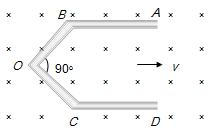
A conductor ABOCD moves along its bisector with a velocity of 1 m/s through a perpendicular magnetic field of 1 wb/m2, as shown in fig. If all the four sides are of 1m length each, then the induced emf between points A and D is

(a) 0

(b) 1.41 volt

(c) 0.71 volt

(d) None of the above

When the intensity of light falling on a surface producing photoelectric effect is doubled, then :
The dimensions of surface charge density is:

The work function of metal is 1 eV. Light of wavelength 3000 Å is incident on this metal surface. The velocity of emitted photo-electrons will be

(a) 10 m/sec

(b) 1  m/sec

(c)  m/sec

(d)  m/sec

The direction of current in an iron-copper thermocouple is

(a) From copper to iron at the hot junction

(b) From iron to copper at the hot junction

(c) From copper to iron at cold junction

(d) No current will flow

Compton effect shows that

(a) X-rays are waves

(b) X-rays have high energy

(c) X-rays can penetrate matter

(d) Photons have momentum

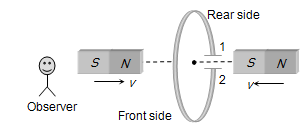
The north and south poles of two identical magnets approach a coil, containing a condenser, with equal speeds from opposite sides. Then

(a) Plate 1 will be negative and plate 2 positive

(b) Plate 1 will be positive and plate 2 negative

(c) Both the plates will be positive

(d) Both the plates will be negative

Let I1 and I2 be the moments of inertia of two bodies of identical geometrical shape, the first made of aluminium and the second of iron.
  1. I1 < I2
  2. I1 = I2
  3. I1 < I2
  4. Relation between I1 and I2 depends on the actual shapes of the bodies. 

Astigmatism (for a human eye) can be removed by using

(a) Concave lens

(b) Convex lens 

(c) Cylindrical lens

(d) Prismatic lens 

Two charged particles traverse identical helical paths in a completely opposite sense in a uniform magnetic field.