Question

For a given surface the Gauss's law is stated as  From this we can conclude that         

(a) E is necessarily zero on the surface

(b) E is perpendicular to the surface at every point

(c) The total flux through the surface is zero

(d) The flux is only going out of the surface

Answer

(c) The total flux through the surface is zero

Need a full question paper?

Generate a complete, print-ready paper with questions like this in minutes — across 16+ boards, with answer keys.

Start Generating Free

Similar questions

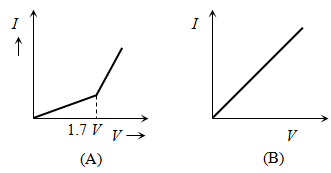
The V-i graphs A and B drawn for two voltameters. Identify each graph

(a) A for water voltameter and B for Cu  voltameter

(b) A for Cu  voltameter and B for water voltameter

(c) Both A and B represents Cu  voltameter

(d) None of these

The distance between the plates of a parallel plate condenser is 4mm and potential difference is 60 volts. If the distance between the plates is increased to 12mm, then

(a) The potential difference of the condenser will become 180 volts

(b) The P.D. will become 20 volts

(c) The P.D. will remain unchanged

(d) The charge on condenser will reduce to one third

Assertion   :  In a simple battery circuit the point of lowest potential is positive terminal of the battery

Reason      : The current flows towards the point of the higher potential as it flows in such a circuit from the negative to the positive terminal.

(a) If both assertion and reason are true and the reason is the correct explanation of the assertion.

(b) If both assertion and reason are true but reason is not the correct explanation of the assertion.

(c) If assertion is true but reason is false.

(d) If the assertion and reason both are false.

A uniform spherical shell gradually shrinks maintaining its shape. The gravitational potential at the centre:
  1. Increases.
  2. Decreases.
  3. Remains constant.
  4. Oscillates.

A 10 μF capacitor is charged to a potential difference of 50 V and is connected to another uncharged capacitor in parallel. Now the common potential difference becomes 20 volt. The capacitance of second capacitor is

(a) 10 μF  

(b) 20 μF

(c) 30 μF

(d) 15 μF

A charged particle in a plasma trapped in a magnetic bottle leaks out after a millisecond. What is the total work done by the magnetic field during the time the particle is trapped?

Two capacitors A and B are connected in series with a battery as shown in the figure. When the switch S is closed and the two capacitors get charged fully, then

(a) The potential difference across the plates of A is 4V and across the plates of B is 6V

(b) The potential difference across the plates of A is 6V and across the plates of B is 4V

(c) The ratio of electrical energies stored in A and B is 2 : 3

(d) The ratio of charges on A and B is 3 : 2

Two parallel plates separated by a distance of 5mm are kept at a potential difference of 50 V. A particle  of mass   and charge   enters in it with a velocity .  The acceleration of the particle will be

(a)  

(b)  

(c)

(d) 2 

In series combination of capacitors the effective capacitance:

In the depletion region of an unbiased P-N junction diode there are

(a) Only electrons

(b) Only holes

(c) Both electrons and holes

(d) Only fixed ions