MCQ
For a particle in a non-uniform accelerated circular motion
  • A
    Velocity is radial and acceleration is transverse only
  • B
    Velocity is transverse and acceleration is radial only
  • C
    Velocity is radial and acceleration has both radial and transverse components
  • Velocity is transverse and acceleration has both radial and transverse components

Answer

Correct option: D.
Velocity is transverse and acceleration has both radial and transverse components
d
(d)In non-uniform circular motion particle possess both centripetal as well as tangential acceleration.

Need a full question paper?

Generate a complete, print-ready paper with questions like this in minutes — across 16+ boards, with answer keys.

Start Generating Free

Similar questions

A liquid column of height $0.04 \mathrm{~cm}$ balances excess pressure of soap bubble of certain radius. If density of liquid is $8 \times 10^3 \mathrm{~kg} \mathrm{~m}^{-3}$ and surface tension of soap solution is $0.28 \mathrm{Nm}^{-1}$, then diameter of the soap bubble is . . . . . . .. . $\mathrm{cm}$.

$\text { (if } g=10 \mathrm{~ms}^{-2} \text { ) }$

If the collision frequency of hydrogen molecules in a closed chamber at $27^{\circ} \mathrm{C}$ is $\mathrm{Z}$, then the collision frequency of the same system at $127^{\circ} \mathrm{C}$ is :
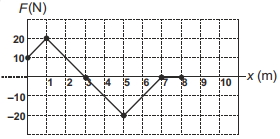
Figure shows the variation of a force $F$ acting on a particle along $x$-axis. If the particle begins at rest at $x=0$, what is the particle's coordinate when it again has zero speed?
Quantity $Z$ varies with $x$ and $y$ , according to given equation $Z = x^2y - xy^2$ , where $x = 3.0 \pm 0.1$ and $y = 2.0 \pm 0.1$ . The value of $Z$ is 
Two particles are performing simple harmonic motion in a straight line about the same equilibrium point. The amplitude and time period for both particles are same and equal to $A$ and $T,$  respectively. At time $t=0$ one particle has displacement $A$ while the other one has displacement $\frac {-A}{2}$ and they are moving towards each other. If they cross each other at time $t,$ then $t$ is
A stone is released from a hot air balloon which is rising steadily with a velocity of $4ms^{-1}.$ The velocity of the stone at the end of $3s$ after it is released is $......... ms^{-1}$
A Merry$-$go$-$round, made of a ring$-$like platform of radius $R$ and mass $M$, is revolving with angular speed $\omega$ A person of mass $M$ is standing on it. At one instant, the person jumps off the round, radially away from the centre of the round $($as seen from the round$)$. The speed of the round afterwards is:
Mars has about $\frac{1}{10}^\text{th}$ as much mass as the earth and half as great a diameter. The acceleration of a falling body on Mars is about:
If two similar springs each of spring constant $K _{1}$ are joined in series, the new spring constant and time period would be changed by a factor
A tunnel is dug along the diameter of earth of mass $'M'$ and then a mass $'m'$ is released a distance $'X'$ from centre so that the time period of oscillation is $T$ . If mass $'4m'$ is released from same point then time period of oscillation will be