MCQ
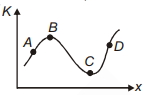
For a particle moving under the action of a variable force, kinetic energy-position graph is given, then
  • A
    At $A$ particle is decelerating
  • B
    At $B$ particle is accelerating
  • C
    At $C$ particle has maximum velocity
  • At $D$ particle has maximum acceleration
Answer

Correct option: D.
At $D$ particle has maximum acceleration
d
(d)

$F . d x=d K$

$\frac{d K}{d x}=F$

$\Rightarrow$ Slope of $K-x$ curve gives force

So slope is max at $D$, hence acceleration is maximum at $D$

Need a full question paper?

Generate a complete, print-ready paper with questions like this in minutes — across 16+ boards, with answer keys.

Start Generating Free

Similar questions

In displacement method, convex lens forms a real image of an object for its two different positions. If heights of the images in two cases be $24 \,cm$ and $6 \,cm$, then the height of the object is ........ $cm$
Assertion : Four point charges $q_1,$ $q_2$, $q_3$ and $q_4$ are as shown in figure. The flux over the shown Gaussian surface depends only on charges $q_1$ and $q_2$.

Reason : Electric field at all points on Gaussian surface depends only on charges $q_1$ and $q_2$ .

A very long solenoid of radius $R$ is carrying current $I\left( t \right) = kt{e^{ - \alpha t}}\,\left( {k > 0} \right)$ , as a function of time $(t  \geq  0)$. counter clockwise current is taken to be positive. A circular conducting coil of radius $2R$ is placed in the equatorial plane of the solenoid and concentric with the solenoid. The current induced in the outer coil is correctly depicted, as a function of time, by
Given below are two statements: one is labelled as Assertion $A$ and the other is labelled as Reason $R$

Assertion $A$: Steel is used in the construction of buildings and bridges.

Reason $R:$ Steel is more elastic and its elastic limit is high.

In the light of above statements, choose the most appropriate answer from the options given below

The increasing order of atomic radii of the following Group $13$ elements is
Two waves are represented by ${y_1} = a\sin \left( {\omega \,t + \frac{\pi }{6}} \right)$ and ${y_2} = a\cos \omega \,t$. What will be their resultant amplitude
A particle starts from the point $(0,8)$ metre and moves with uniform velocity of $\vec{v}=3 \hat{i} \,m / s$. What is the angular momentum of the particle after $5 \,s$ about origin is ........... $kg m ^2 / s$ (mass of particle is $1 \,kg$ )?
The charge flowing through a resistor $R$ varies with time $t$ as $Q = 3t -6t^2.$ The heat produced in $R$ till the current in it becomes zero is 
Two concentric spherical shells of radius $R_1$ and $R_2$ have $q_1$ and $q_2$ charge respectively as shown in figure. How much charge will flow through key $k$ when it is closed
Look at the drawing given in the figure which has been drawn with ink of uniform line-thickness. The mass of ink used to draw each of the two inner circles, and each of the two line segments is $m$. The mass of the ink used to draw the outer circle is $6 \mathrm{~m}$. The coordinates of the centres of the different parts are: outer circle $(0,0)$, left inner circle $(-a, a)$, right inner circle $(a, a)$, vertical line $(0,0)$ and horizontal line $(0,-a)$. The $y$-coordinate of the centre of mass of the ink in this drawing is